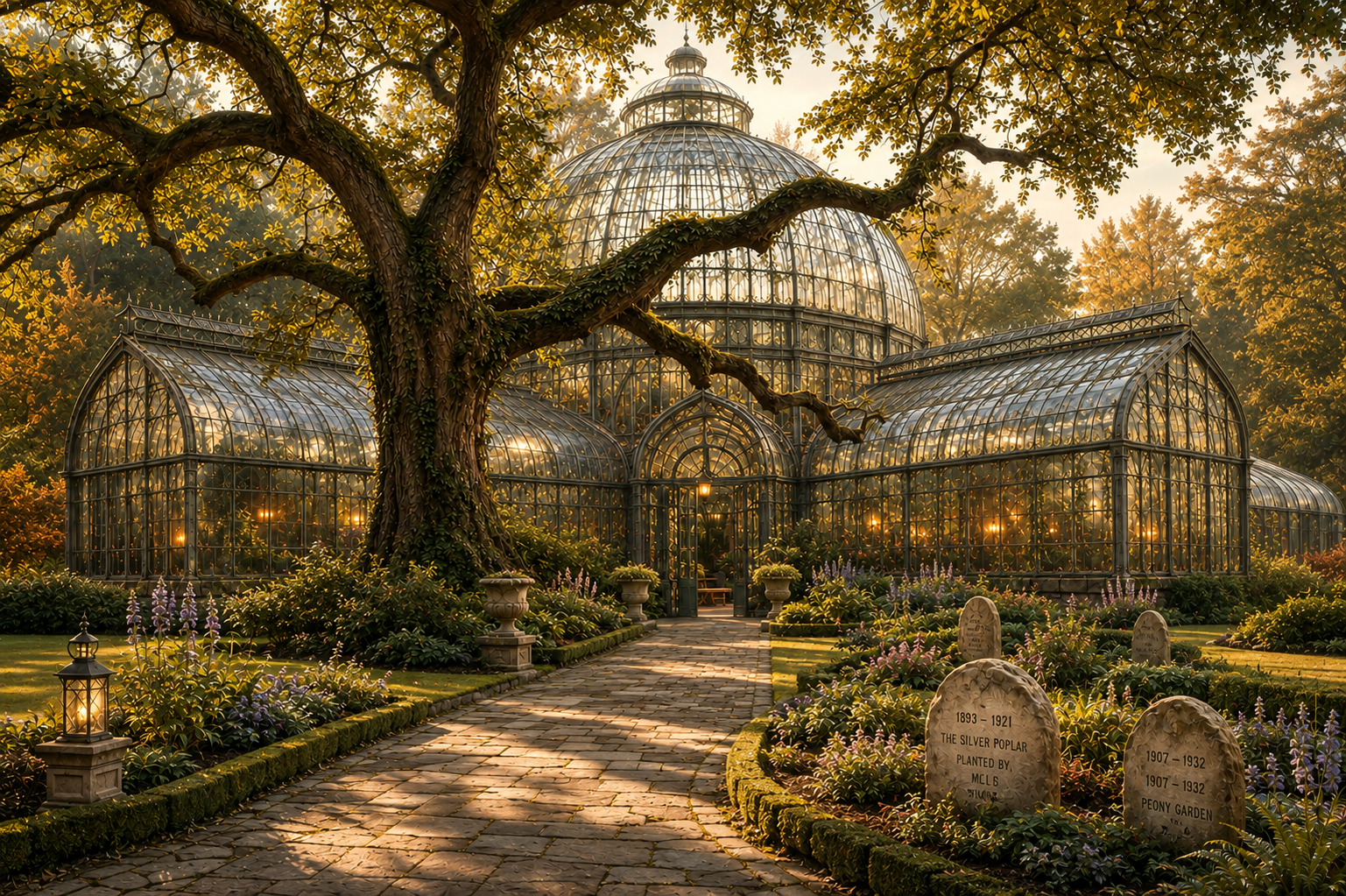
Vapor & Bloom
Bloom Conservatory
Nothing living is kept by being left alone.
Collection I · Now Open
Enter The Keeping GardenAbout the Institution
Bloom Conservatory
Some things remain alive because we return. Bloom Conservatory explores the living remembrance carried through gardens, cultivation, and the practices passed between generations. We observe what has changed and respond to what is needed, making room for growth, dormancy, loss, and renewal. Here, tending is a form of stewardship: a way to honor what shaped us while allowing living things to continue on their own terms.
A conservatory for all that cannot survive behind glass.
Keeper’s Vow
I will keep returning.
Institutional Purpose
Living preservation requires relationship.
A museum can place an object behind glass. An archive can store a document in a protected room. But a garden cannot survive that way.
Living things must be watered, pruned, divided, replanted, and sometimes allowed to die. Their needs change with weather, season, age, illness, and the conditions surrounding them.
To preserve them, someone must remain in relationship with them.
That is the work of Bloom Conservatory.
The Conservatory preserves forms of living remembrance: inherited gardens, botanical traditions, seed collections, field journals, watercolor paintings, cultivation records, and the ordinary practices of tending passed from one generation to another.
But it is not simply an institution about flowers. The garden provides a way to understand how human beings care for anything that changes over time, including relationships, communities, traditions, places, and themselves.
Living Remembrance
To remember a living thing is to remain answerable to what it needs now.
Bloom Conservatory remembers through cultivation and return. It does not ask only how something once looked, what it once meant, or who once cared for it.
It asks whether the relationship that sustained it is still being practiced, and whether present care is responding to the living thing that exists now rather than only to the memory of what it once was.
The Keeper
Conservator of Living Collections
The person who agrees to come back.
The Conservator of Living Collections stewards what cannot survive through preservation alone.
The Conservator remains in relationship with what has been entrusted: observing change, responding to need, cultivating where growth is possible, pruning or releasing where care requires it, and returning as often as the living collection demands.
The office does not seek to hold living things unchanged. Its responsibility is to preserve continuity without denying change, and to strengthen what has been received so that life, knowledge, practice, and relationship may continue beyond the present Keeper.
The Practice of Devotion
Care is not a single grand gesture.
Devotion is often imagined as a feeling that remains constant or a promise never interrupted by exhaustion, failure, distance, or loss. The Conservatory understands it differently.
Devotion is the repeated choice to reenter the relationship. It is the willingness to look again, learn again, and respond to the living thing that is present, not only to the memory of what it once was.
Return does not erase an absence. It makes care possible again.
The Work of the Conservatory
Living preservation requires practice.
The Conservatory’s work is performed through repeated acts of attention. Each practice responds to change rather than attempting to hold a living thing perfectly still.
Observe
Notice what has changed.
Look closely enough to recognize what is different, what is thriving, what is struggling, and what the present conditions require.
Cultivate
Create the conditions in which life may continue.
Sustain the soil, relationships, knowledge, space, and attention through which living things may grow, adapt, and remain capable of renewal.
Tend
Respond to what is needed now.
Care through the ordinary repeated work of watering, pruning, supporting, protecting, repairing, waiting, and adjusting as conditions change.
Record
Keep the living record alongside the living collection.
Preserve growth, change, loss, cultivation, failure, recovery, and inherited knowledge so that the next Keeper receives more than the visible result.
Return
Begin again with what is present.
Come back after growth, failure, dormancy, absence, weather, change, or loss and attend to the living thing that exists now.
Entrust
Prepare care to continue beyond the present Keeper.
Strengthen what has been tended, preserve what has been learned, and pass forward the relationships, knowledge, practices, and responsibilities required for continuation.
Observe what is changing. Cultivate what may grow. Tend what requires care. Record what the next Keeper should know. Return when conditions change. Entrust what must continue.
Living Collections as Teachers
What has this living thing been faithfully practicing all along?
In Bloom Conservatory, a living collection is not merely decorative material or a convenient metaphor. It is a subject of attention in its own right.
The Conservatory does not begin by deciding what a plant, garden, seed, landscape, or cultivated practice should symbolize. It begins by observing what the living system is actually doing.
Growth, dormancy, dependence, succession, adaptation, division, decay, propagation, and recovery can each reveal something about the conditions under which living things continue.
Continuation requires conditions in which change is possible.
An absence of visible growth is not always an absence of life.
What appears self-sustaining may rely upon relationships that remain largely unseen.
Faithful continuation may require change rather than resistance to it.
Some living things endure because what has grown is divided, shared, replanted, or entrusted elsewhere.
Not everything can or should remain unchanged, and care must sometimes make room for an ending.
What Is Preserved Here
Evidence of living relationship
The Conservatory collects objects, specimens, and records when they preserve, document, or extend a practice of care.
Living Collections
Seeds, bulbs, cuttings, divided plants, inherited gardens, cultivated specimens, and other living material kept through continued relationship.
Field Records
Observations of growth, weather, soil, failure, recovery, succession, and seasonal change.
Botanical Art
Watercolors, illustrations, and visual studies created through sustained attention to living subjects.
Inherited Practices
Methods of planting, pruning, propagation, cultivation, observation, and tending passed between generations.
Tending Practices
Repeatable acts through which care becomes something practiced rather than merely admired.
Records of Change and Loss
Failed plantings, altered landscapes, dormant seasons, changed relationships, and evidence of what could not be preserved unchanged.
The Keeper Within the Living World
Care does not move in only one direction.
At first, the Keeper may imagine that the living collection depends entirely upon them. With time, they begin to recognize a larger web of dependence.
The Keeper is fed, sheltered, taught, interrupted, restored, and changed by the same living world they have agreed to tend. They do not stand outside it as its owner.
They belong within the system of relationships they are trying to keep.
To care for a living world is also to accept that you are one of the lives being held within it.
Questions Kept Here
The Conservatory asks:
- What remains alive because someone chooses to keep returning?
- When does care require preservation, and when does it require change?
- What can dormancy, adaptation, recovery, or loss teach us about continuation?
- What relationships sustain what appears to stand alone?
- What does it mean to belong to something rather than simply care for it?
- What has this living thing been faithfully practicing all along?
- What are we willing to keep returning to?
Bloom Conservatory · Collection I
The Keeping Garden
What remains alive because someone chooses to tend it?
Bloom Conservatory’s first collection follows the formation of a Keeper through a sequence of Garden Beds, each presenting a living subject and a different discipline of care.
The journey moves through pruning, observing, waiting, releasing, tending, stewarding, sharing, and returning. With each passage, the visitor’s understanding of preservation becomes less static and more relational.
Gradually, the Keeper discovers that care is not performed from safely outside the garden. They also exist within its web of dependence. What has been received must eventually be shared, entrusted, and carried beyond the gate.
Prune
Observe
Wait
Release
Tend
Steward
Share
Return
The garden is kept by returning. The Keeper is changed by return.
Enter The Keeping Garden Open Collection I →