BLOOM CONSERVATORY
COLLECTION I
THE KEEPING GARDEN
Remembrance practiced as return.
Some things survive only because someone comes back.ENTER THE GARDEN
About this collection
Free to explore online. Related physical items are available to purchase.
What you’ll explore
Eight garden practices offer ways to think about caring for living things, relationships, and the work entrusted to us—from pruning and waiting to sharing and returning.
Sources & works
Original botanical watercolors by Victoria Rose Gray, paired with plants’ natural history and reflections from writers including Wendell Berry, Robin Wall Kimmerer, and Aldo Leopold.
Art, books & objects
Botanical art prints, an illustrated hardcover reading book, and a book-and-writing-companion set with guided prompts and room for your observations.
View the art & booksBEFORE ENTERING
A GARDEN IS
NOT AN ARCHIVE
An archive protects an object from change.
A garden survives by changing.
Not everything entrusted to us can be preserved by leaving it untouched. Some things must be pruned. Some observed. Some allowed to disappear. Some kept alive through the quiet decision to return.
The Keeping Garden is arranged around eight practices of living remembrance. Each bed asks something different of its keeper: to prune, observe, wait, release, tend, steward, share, and return.
There is no single correct path through the garden.
But every path eventually returns to the gate.
BC–KG–COL.I · ENTRY RECORD
BLOOM CONSERVATORY · COLLECTION I
PLAN OF THE
KEEPING GARDEN
Select a bed to begin, or follow the path in order.

Swipe across the plan to explore the garden.
The path is yours to choose.
BEGIN AT BED IBC–KG–PLAN.01 · GARDEN RECORD · KEEP ON SITE

A Keeper Who Helped Tend This Work
The Victoria Rose Collection
The Keeping Garden began long before Bloom Conservatory had a name.
It began in the attentive hands of Victoria Rose Gray, who painted the flowers growing not as specimens removed from life, but as living presences—encountered in season, observed with affection, and carried forward through the patient work of looking.
Within Bloom Conservatory, these watercolors are more than illustrations. They are evidence of one person teaching another how to notice.
Each painting passes through two sets of hands: the mother who first tended and observed the bloom, and the daughter who later recognized within it a larger human question. Together, they form a record of remembrance as Bloom Conservatory understands it—not the preservation of something unchanged, but the continuation of care across time, distance, and relationship.
The flowers will open and disappear. The garden will alter. Even the hands that painted them will change. But something of the encounter remains: a particular bloom, seen closely; a moment of attention, given freely; a way of loving the living world, handed forward.
The Victoria Rose Collection is therefore not merely held by Bloom Conservatory. In many ways, it is one of the things from which the Conservatory grew.
Bloom Conservatory
Collection I · The Keeping Garden
Learning to Cultivate
The garden begins with practice.
Before the Keeper can understand belonging, the Keeper must learn how to meet a living thing with attention: to prune without destroying, observe before acting, wait without abandoning, release what cannot remain, and tend what quietly sustains the whole.
The first movement does not ask how the garden may be controlled. It asks how it may be cultivated faithfully.
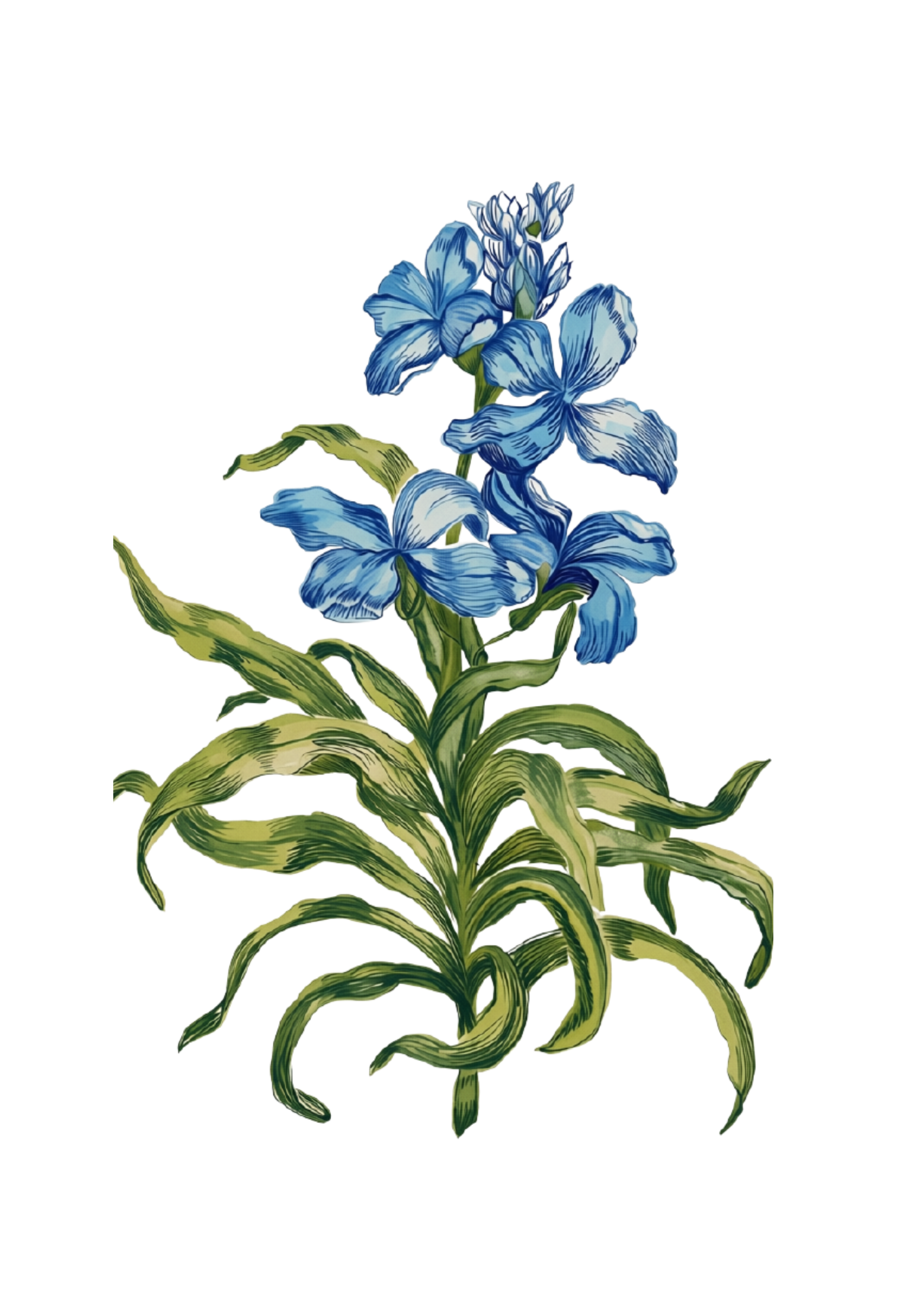
Prune
Wallflower Erysimum sp.
The Cut That Keeps
What kind of love is willing to wound so that life may continue?
The first Garden Bed introduces the Keeper to a difficult paradox: devotion is not always expressed by preserving what is. Sometimes the deepest act of care is a careful interruption made in service of future flourishing.
After flowering, the wallflower is cut back. Spent stems are removed so that fresh growth may emerge and the plant may remain vigorous. To an unfamiliar eye, the act can appear contradictory: a living thing is interrupted at the very moment it seems most beautiful.
Yet the gardener understands that the cut is not made in opposition to life. It is made in service of it.
Visitors admire blossoms.
Gardeners admire the cuts that made the blossoms possible.
A faithful gardener does not prune carelessly. The plant is first observed. Its season is understood. Only what has completed its work is removed, and the gardener remains afterward to continue the work of tending.
There is a profound difference between wounds that diminish life and wounds accepted so that life may continue. The distinction does not lie merely in the presence of the cut, but in its purpose.
The cut is never the goal.
Flourishing is.
The garden quietly challenges a common misunderstanding of devotion. We often imagine that loving something means leaving it exactly as it is. Yet the wallflower has long been practicing another kind of wisdom: there are moments when care asks not for passive preservation, but for discernment, restraint, and the courage to continue differently.

For Further Tending
Observe a recently pruned garden. Notice what has been removed—and what has been made possible because of it.
Where have I mistaken loving intervention for harm?
Garden Bed II
Observe
Hepatica Hepatica nobilis
The Discipline of Attention
What reveals itself only through faithful return?
The second Garden Bed invites the Keeper into a quieter discipline. Not every act of devotion changes the world through intervention. Some forms of love are expressed simply by remaining long enough for the world to reveal itself.
Hepatica appears very early in spring, often before the surrounding woodland has fully awakened. Its blossoms are small, close to the forest floor, and easily overlooked by those moving quickly through the landscape.
The flower does not compete for attention.
It rewards attention.

Its lesson is not hidden because it is secret.
It is hidden because it is quiet.
Visitors often believe they are looking at the garden.
Over time, they discover the garden has been teaching them how to look.
When we first enter a woodland in early spring, we notice what is obvious. Bright blossoms, towering trees, and sweeping landscapes draw the eye toward what asks to be seen.
Hepatica asks for something different. It does not announce itself through spectacle. It appears quietly among last year’s leaves, trusting neither speed nor novelty to secure our attention.
Those who return begin to notice something remarkable. The same path is never quite the same. The light falls differently. A new fern has unfurled. Hepatica has appeared where yesterday there seemed to be only leaf litter.
The garden has not become more interesting.
The observer has become more attentive.
Attention is an act of humility. It assumes that the world still has something to say, and that our first responsibility is not always to improve it, but to receive it faithfully.
Some gardens are not waiting for our hands.
They are waiting for our attention.

For Further Tending
Return to the same tree, garden, or path. Record only what has changed since your last visit. Resist the urge to search for something extraordinary.
Allow familiarity to become your teacher.
What in my life have I stopped seeing simply because it became familiar?
Garden Bed III
WAIT
The Unhurried Garden
What does devotion do
after it has done all it can?
The gardener prepares the soil, plants the bulb, protects the bed, and tends the ground. Then faithful devotion reaches a threshold beyond which action must give way to trust.

A Flower That Keeps
Its Own Calendar
The Snowdrop emerges at the threshold of spring, often flowering while winter still lingers around it. Its appearance cannot be forced, accelerated, or persuaded. It rises only when its own season has arrived.
Its natural history teaches that faithful cultivation prepares the conditions for life without presuming to control its unfolding.
Bloom Conservatory chooses specimens for the wisdom of their natural history rather than for inherited symbolic meaning.
Preparation belongs to the gardener.
Timing belongs to life.
The Practice of Patience
The Snowdrop
The Snowdrop does not bloom because the gardener has become impatient. It blooms because the season is ready.
Rainer Maria Rilke
Some questions cannot be answered through urgency. They must be lived with patiently until understanding ripens in its own time.
Wendell Berry
Cultivation is measured in seasons rather than moments. Care prepares the conditions for flourishing, but never possesses the harvest.
Some things cannot be loved into growing faster.
The flower knew this before anyone thought to write it down.
The Conservatory has noticed that gardeners spend remarkable amounts of time waiting.
They prepare the soil. They plant the bulb. They water. They protect. Then they stop—not because nothing is happening, but because there comes a point when further action no longer belongs to the gardener.
Beneath the frozen ground, roots awaken without applause. Cells divide unnoticed. Moisture gathers. The patient work of becoming continues beyond the reach of human hands.
The hurried observer mistakes stillness for absence. The gardener learns otherwise. Faithful cultivation does not consist in constant activity. It consists in recognizing the moment when care has become trust.
The garden quietly resists the belief that devotion grants control. There are gifts that cannot be demanded, seasons that cannot be shortened, and forms of life that mature only in their own time.
Trust is not the opposite of care.
It is the final expression of it.
What Continues
Beneath the Surface
- Seeds germinating beneath the soil
- Compost becoming fertile earth
- Young orchards maturing over decades
- Bodies recovering from illness or injury
- Children growing into themselves
- Grief slowly reshaping the heart
- Long friendships deepening through ordinary presence
- Restored ecosystems returning one season at a time
Some forms of love remain faithful by trusting time rather than trying to master it.
Botanical Plate

Snowdrop · Galanthus nivalis
Victoria Rose Collection · Idaho Falls, Idaho · 2026
Plant Something That
Will Not Bloom This Season
Return to it often.
Water it.
Protect it.
Observe it.
Resist the temptation to hurry what cannot be hurried.
Let your attention become an act of trust.
Where am I trying to control
what can only be cultivated?
RELEASE
The Garden Divided
Human Question
How do we know when faithful care must change?
IV
Not every season asks us to care in the same way. Sometimes devotion remains faithful not by holding more tightly, but by allowing relationship to take on a new form.

Continuation
Through Division
The Bearded Iris flourishes through periodic division. As mature clumps become crowded, flowering gradually declines. The attentive gardener lifts the rhizomes, separates them, and replants healthy divisions with room to grow.
What appears to be the breaking apart of the plant is, in truth, one of the primary ways its life continues.
Nothing essential has been lost.
The relationship has entered a new season.Its natural history teaches that faithful cultivation sometimes asks us to continue differently rather than continue identically.
Bloom Conservatory chooses specimens for the wisdom of their natural history rather than for inherited symbolic meaning.
Memory
Care
Continuity
Movement
Renewal
Flourishing
Continuity Without Possession
The Bearded Iris
The iris does not remain healthy by remaining unchanged. When the clump becomes crowded, division becomes an act of renewal rather than destruction.
Lewis Hyde
The GiftCertain gifts remain alive only by continuing to circulate. What is held too tightly eventually loses the life it was intended to preserve.
Robin Wall Kimmerer
Braiding SweetgrassHealthy relationships are sustained through reciprocity rather than ownership. Stewardship asks how we may participate in continued flourishing.
Some things continue because they are allowed
The flower knew this before anyone thought to write it down.
to become something new.
An iris may flourish for years in the same place, but eventually the attentive gardener notices subtle changes. The blooms become fewer. The center of the clump grows crowded. What once served the plant faithfully now begins, quietly, to limit its flourishing.
The answer is not abandonment. Nor is it tighter possession. The gardener kneels, lifts the rhizomes from the earth, and gently divides what has become one into many.
To an unfamiliar eye, it appears as though something precious has been broken apart. The gardener knows otherwise. Nothing essential has been lost. Life has simply continued in a different form.
One of devotion’s deepest temptations is to confuse permanence with faithfulness. We imagine that caring well means preserving every relationship exactly as we first received it. Gardens refuse this illusion.
Faithful cultivation is not measured by how tightly one holds, but by whether care is allowed to mature alongside the living thing itself.
Some relationships are not diminished by change.
They are fulfilled through it.
The Forms
Continuation Takes
- 01 Dividing perennial plants
- 02 Saving and sharing seed
- 03 Apprenticeship becoming mastery
- 04 Teachers releasing students into their own work
- 05 Parents watching children become adults
- 06 Family traditions carried into new generations
- 07 Ecological succession renewing a landscape
- 08 Communities strengthened as responsibility is shared
Some things endure because they are allowed to continue in a new form.
Botanical Plate

Bearded Iris · Iris germanica
Victoria Rose Collection · Idaho Falls, Idaho · 2026
Divide It
With Care
If you tend a perennial that has outgrown its place, divide it carefully.
Replant one division. Give another away.
Return in the following seasons to watch both continue growing.
Where am I trying to preserve yesterday’s form of care when life is asking me to cultivate it differently?
TEND
The Quiet Work
Human Question
What has been quietly making every previous lesson possible?
The Keeper has learned the visible disciplines of cultivation. Here, every visible act is revealed to depend upon a hidden community of relationships already at work beneath the surface.

Flourishing has never been the achievement of a single flower.
It has always been the work of an ecology.The Blossom
Points Below
The peony is often admired for its spectacular bloom. Yet its beauty is impossible apart from the living soil beneath it—a vast community of roots, fungi, earthworms, decaying leaves, microorganisms, moisture, insects, and seasons of patient transformation.
Visitors naturally lift their eyes toward the blossom. The flower gently lowers them again.
Every visible flourishing depends upon countless relationships that rarely ask to be noticed.
Bloom Conservatory chooses specimens whose flourishing reveals the hidden ecology that sustains them. Sometimes the flower’s greatest lesson is to direct our attention elsewhere.
Another Garden Quietly Unfolds
Roots
Search for water beyond the reach of the blossom.
Fungi
Exchange nourishment through invisible threads.
Earthworms
Loosen and remake the ground through quiet movement.
Fallen Leaves
Surrender yesterday’s life to tomorrow’s growth.
Microorganisms
Labor continuously without recognition or applause.
Time
Transforms what has fallen into nourishment.
Nothing beneath the surface asks to be admired.
Nothing blooms.
Yet everything above depends upon what happens below.
The Work That Does Not Ask to Be Seen
The Peony
The peony blooms brilliantly, yet every blossom points beyond itself. Its life depends upon relationships the flower neither commands nor replaces.
Brother Lawrence
Meaningful labor often leaves little visible evidence of itself, quietly sustaining the lives of others through humble constancy.
Robin Wall Kimmerer
The living world is woven through reciprocity. Gardens flourish because countless organisms continually give and receive what the whole requires.
The most essential work is often the least visible.
The flower has always known this.
Beneath every blossom, another garden quietly unfolds. For every flower that catches the morning light, countless relationships have already prepared the conditions under which that flower could exist.
The Keeper slowly realizes that this has been true of every previous Garden Bed.
None of these practices disappear when they are finished. They become soil. Every faithful act leaves behind something that nourishes what comes next.
The garden remembers differently than we do. It does not preserve every fallen leaf. It transforms it. Yesterday’s life becomes tomorrow’s nourishment.
Perhaps devotion remembers in much the same way—not by holding the past unchanged, but by allowing it to become the quiet ground from which new life may emerge.
The garden has never been teaching individual virtues.
It has been teaching ecology.
What Makes
Flourishing Possible
- Healthy soil beneath every thriving garden
- Compost becoming nourishment for future growth
- Mycorrhizal fungi connecting neighboring plants
- Pollinators moving unnoticed between blossoms
- Caregivers whose labor is rarely celebrated
- Custodians preparing spaces before others arrive
- Archivists preserving knowledge without recognition
- Night-shift workers keeping the world running
- Teachers whose influence appears years later
- Quiet friendships sustaining lives without demand
The most important work is often the least visible.
Botanical Plate

Peony · Paeonia sp.
Victoria Rose Collection · Idaho Falls, Idaho · 2026
Begin With
the Soil
Kneel beside a garden.
Do not begin with the flowers.
- The fallen leaves
- The insects
- The roots
- The scent of earth after rain
Learn one hidden relationship that makes the garden possible.
Whose quiet faithfulness has become the soil from which my own life has grown?
Bloom Conservatory
Collection I · The Keeping Garden
Learning to Belong
The first movement asked how we cultivate. The second asks how we belong.
Beneath the flowers, the Keeper discovered that no act of care is solitary. Every garden is received already in progress—shaped by forgotten hands and sustained by relationships largely unseen.
The Keeper is no longer learning merely how to care for a garden. The Keeper is learning how to take a faithful place within its continuing life.
STEWARD
Borrowed Time
Human Question
How do we care for what never truly belonged to us?
Having learned the disciplines of cultivation, the Keeper now discovers that every garden is first received before it is ever tended.

The soil was prepared.
The branch was grafted.
The young roots were protected.
The blossom is entrusted.
An Orchard
Already Begun
The blossom is brief.
The inheritance is not.
Apple trees often outlive the people who plant them. Many gardeners tend orchards they did not establish and plant trees whose fullest harvest they may never witness.
Every blossom is supported by years of unseen stewardship—those who prepared the soil, grafted the branches, pruned the limbs, protected the roots, and patiently cared for the tree through seasons now forgotten.
Before the Keeper can ask, “What shall I grow?” the garden quietly asks, “What have you already received?”
Bloom Conservatory chooses specimens whose natural history reveals the responsibilities of stewardship rather than ownership. Faithful cultivation begins with inheritance.
What Arrived Before the Keeper
The Ground
Soil already amended by weather, decay, labor, and time.
The Tree
Roots already established and branches shaped by earlier care.
The Knowledge
Practices learned, corrected, preserved, and passed onward.
The Unfinished Work
A living garden asking not to be completed, but continued.
We inherit far more than we create.
Inheritance Becomes Relationship
The Apple Blossom
The blossom appears for only a short season, yet it depends upon years of patient cultivation. No harvest belongs to one pair of hands alone.
Aldo Leopold
We belong to the land as members of a larger community rather than as its owners. Stewardship begins with participation, not mastery.
Robin Wall Kimmerer
Gratitude transforms possession into relationship. To receive the gifts of the living world is to accept responsibility for their continued flourishing.
The apple blossom blooms because countless seasons have already prepared the tree. Leopold reminds us that we belong to the land before we attempt to manage it. Kimmerer shows how gratitude naturally gives rise to reciprocity.
The blossom has been practicing this wisdom long before anyone thought to write it down.
The Conservatory has never encountered an untouched garden. Every path has been walked before. Every tree bears the marks of earlier hands. The soil remembers forgotten seasons. Even the mistakes have become part of the inheritance.
Stewardship begins not with effort, but with gratitude. Before planting anything new, the Keeper first receives what has already been given.
Devotion is measured not by ownership, but by faithfulness. No Keeper is asked to finish the garden.
Each is asked only to leave it more alive than they found it.
Where Stewardship Replaces Ownership
One inheritance, carried through many hands
Historic orchards cared for across generations
Seed libraries preserving future harvests
Botanical gardens maintained by successive Keepers
Apprenticeship carrying knowledge between craftspeople
Family recipes entrusted from one generation to another
Mentorship preparing others to continue the work
Conservation restoring places we did not create
Old trees still tended by unknown hands
We belong to what we faithfully tend far more than we ever possess it.
Botanical Plate

Apple Blossom · Malus domestica
Victoria Rose Collection · Idaho Falls, Idaho · 2026
Visit an
Old Tree
Do not wonder first how old it is.
Wonder who planted it.
Wonder who watered it through its first summer.
Wonder who pruned it.
Wonder who once gathered beneath its shade.
What have I inherited that asks not to be owned, but faithfully tended before being passed to another?

Devotion reaches its fulfillment when it becomes an inheritance.
Botanical Plate

Learning to Continue
The garden does not ask the Keeper to remain inside it forever.
It opens the gate.RETURN
The Open Gate
Human QuestionHow do we leave what we love without leaving it behind?
The Keeper has learned to cultivate, to belong, and to prepare the garden for hands that follow. One final practice remains: to cross the threshold without confusing departure with abandonment.
The garden cannot be carried whole. Yet its practices can travel—into other rooms, other seasons, other lives, and eventually back through the gate from which they began.
A Threshold
Made for Return
A wall separates. A gate makes relationship possible. It marks a boundary without making the boundary absolute. It can protect what grows within while still allowing the Keeper to depart, to gather what is needed, and to come home changed.
The garden gate does not ask the traveler to choose between belonging and becoming. Its hinges hold both movements: outward into the world and inward toward the place that formed them.
The gate opens both ways. Leaving and returning are not opposing promises. They are one faithful motion.
Bloom Conservatory keeps this architectural specimen because remembrance is not confinement. What has been tended here must be free to travel—and what travels must remain able to return.
Carry It Forward
Leave the garden with its practices in your hands: notice carefully, tend quietly, share freely, and prepare what you love for lives beyond your own.
Departure becomes devotion when the practice travels with you.Come Back Changed
Return with what the road has taught you. The garden is not preserved by pretending no season passed; it is renewed when the Keeper brings new attention home.
Return becomes stewardship when experience is offered back.What the Threshold Knows
The Garden Gate
A gate is useful precisely because it does not stay fixed in one position. Its faithfulness is found in repeated opening: to welcome, to release, to protect, and to receive again.
The Returning Keeper
The Keeper who returns is not the Keeper who left. New knowledge crosses the threshold with them, allowing the old garden to be seen—and tended—anew.
The Living Tradition
A tradition remains alive when it can travel beyond its first form and still find its way home. Continuity is not sameness. It is recognizable care moving through change.
The path carries the Keeper outward. The hinge keeps relationship possible.
For much of the walk, the Keeper believed the garden’s lesson was how to remain: remain attentive, remain patient, remain faithful, remain near. At the gate, this understanding deepens.
Faithfulness is not measured only by duration of presence. Sometimes the work requires leaving— carrying seed elsewhere, making room for another Keeper, or entering a season the garden cannot live on our behalf.
The gate prevents both errors: the belief that belonging requires never leaving, and the belief that leaving requires never looking back. Its two hinges hold a more generous truth.
The garden is not kept by remaining inside it.
It is kept by returning to the practice wherever we stand.
Where Return
Keeps Something Living
- 01Gardeners returning after winter to learn what endured
- 02Adult children carrying home what life has taught them
- 03Students returning as colleagues, mentors, and teachers
- 04Communities revisiting traditions without freezing them in time
- 05Caregivers leaving the bedside and returning restored
- 06Travelers seeing familiar places with newly educated eyes
- 07Seeds gathered elsewhere and planted in remembered soil
- 08Old work approached again with more merciful hands
Return is not reversal.
It is relationship resumed with new capacity.Threshold Study
BC—KG—GB08—TSPractice the
Two-Way Gate
Choose one place, practice, or relationship you have been afraid to leave—or afraid to revisit.
Name what must travel with you when you go.
Name what you are allowed to set down at the threshold.
Leave one clear path by which relationship can continue.
Return when you have something honest to offer back.
What can I carry forward without carrying everything?
Where have I mistaken distance for abandonment?
What promise of return can I keep?A garden is not kept in a single season.
The gate remains because the Keeper must leave.
It remains open because the Keeper has promised to return.Objects from this collection
Carry the garden with you
Botanical prints, a book to return to, and companions for the practice of keeping.