Vapor & Bloom
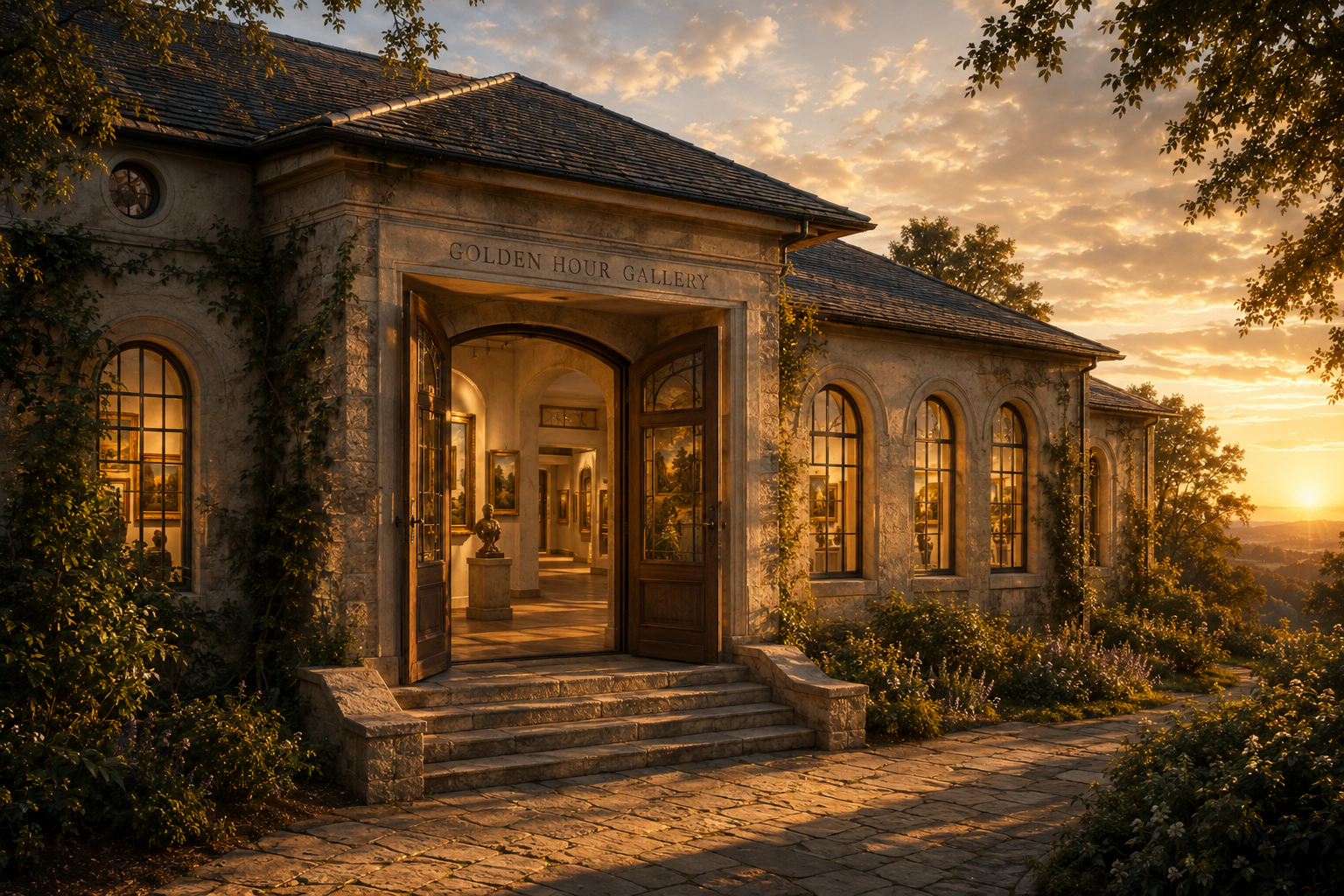
Golden Hour Gallery
The light is here now.
What becomes visible when we choose to look again?
Collection I · Now Open
Enter Because It Was SeenAbout the Institution
Golden Hour Gallery
Golden Hour Gallery invites the second look through which a person, place, gesture, or ordinary moment becomes newly visible. Through art and other forms of witness, we attend to the conditions of recognition: light, framing, context, and the voices that shape understanding. Our work makes space for significance already present, honoring the subject’s dignity and agency, the maker’s attribution, and the complexity of what remains beyond our claim.
Keeper’s Vow
I will help others see.
The Practice of Looking Again
Recognition begins when familiarity is no longer mistaken for understanding.
Golden Hour Gallery studies the conditions under which something ordinary, overlooked, misunderstood, or simply too familiar to notice may be encountered again.
The subject does not need to become more beautiful, dramatic, or important in order to deserve attention.
Sometimes nothing about the subject changes at all. The witness changes position. The frame widens. Context returns. Another piece of testimony is placed beside what was already visible. Light reaches a surface from a different direction.
The Gallery does not manufacture significance. It changes the conditions of looking until what is already present can be recognized more fully.
The Keeper
Scenographer of Witness and Light
The Scenographer keeps the conditions of seeing.
The Scenographer of Witness and Light arranges the conditions under which something familiar, overlooked, or difficult to perceive may be encountered anew.
Through position, context, composition, testimony, sequence, and light, the Scenographer creates room for recognition without claiming possession of what becomes visible.
The subject is not made important by being observed. The Scenographer’s responsibility is to resist replacing the subject’s meaning with the Keeper’s interpretation and to preserve enough context that the witness may encounter what is already there.
Conditions of Recognition
Recognition can change even when the subject does not.
The Gallery studies how perception shifts when the conditions of encounter are changed with care.
Position
Where the witness stands matters.
Distance, proximity, orientation, and point of view influence what can be noticed and what remains outside the frame.
Frame
Every act of seeing includes and excludes.
A frame can isolate a detail, restore surrounding context, or reveal that what first appeared complete was only a fragment.
Light
Illumination changes what can be perceived.
Light may reveal texture, absence, wear, gesture, atmosphere, and evidence that remains present but unnoticed under other conditions.
Sequence
Meaning changes when one thing is placed beside another.
Repetition, juxtaposition, chronology, and return can allow a relationship to emerge that a single isolated image or object could not hold alone.
Testimony
Context may change what the witness thought they understood.
A caption, letter, remembered scene, subject account, or witness statement can return agency and context to what might otherwise be interpreted only from appearance.
Attention
Looking again is itself a discipline.
Recognition requires enough time and care for the witness to move beyond first impression, habit, assumption, and visual familiarity.
The Scenographer does not determine what the witness must see. The work is to make a more faithful encounter possible.
The Work of the Gallery
Recognition is cultivated through disciplined attention.
The Gallery changes the conditions of encounter rather than the inherent worth of the subject. Its work moves through five recurring practices.
Attend
Stay long enough for first impression to loosen.
Notice what habit, haste, familiarity, or expectation may have allowed to disappear from view.
Position
Consider where the witness stands.
Change distance, orientation, proximity, sequence, or point of view when doing so creates a more faithful encounter.
Frame
Decide what must remain in view.
Isolate a detail when necessary, widen the frame when context has been lost, and remain aware that every frame includes some things while excluding others.
Witness
Preserve presence without claiming possession.
Attend to the subject, its context, testimony, agency, and traces without confusing observation with ownership or interpretation with authority.
Recognize
Allow the encounter to become newly legible.
Recognition occurs when something already present can be encountered with enough attention, context, and care to be seen differently without being made into something else.
Attend carefully. Position deliberately. Frame responsibly. Witness without possession. Make room for recognition.
Recognized Evidence
What attention preserves
The Gallery receives evidence wherever careful looking preserves the subject, its context, the conditions of encounter, and the moment in which recognition became possible.
Photographs
Images that preserve position, gesture, environment, sequence, and traces of ordinary life.
Paintings and Drawings
Visual studies in which attention, interpretation, texture, repetition, and framing remain visible in the work itself.
Diptychs and Polyptychs
Paired or sequential images that allow position, time, contradiction, or changed understanding to become visible.
Repeated Subjects
The same person, place, object, or gesture encountered again under different conditions of time, light, distance, or attention.
Objects in Context
Ordinary things preserved within the relationships, rooms, work, and histories that allow their meaning to remain legible.
Written Scenes
Short literary or documentary passages that preserve a moment, perspective, atmosphere, or shift in recognition.
Letters and Testimony
Subject accounts, witness statements, remembered scenes, correspondence, and other first-person context.
Captions and Fragments
Small pieces of language that alter, complicate, or restore context without exhausting the meaning of the subject.
Records of Position
Notes documenting where the witness stood, what changed, what remained outside the frame, and how the encounter was shaped.
Subject-Selected Evidence
Objects, images, language, or records chosen by the subject when their own selection is necessary to preserve agency and meaning.
Curatorial Notes
Records of framing decisions, uncertainty, ethical limits, context, sequence, and the conditions under which work is shown.
Records of Attention
Evidence of what became visible only after someone returned, stayed longer, changed position, or looked again.
Ethics of Witness
The Gallery makes visible without claiming possession.
Careful attention does not grant ownership over the subject, its story, its image, or its meaning.
The Gallery preserves context, consent, agency, attribution, and subject voice wherever those things are necessary to a faithful encounter.
A witness may describe what they saw. A Scenographer may arrange the conditions under which something becomes newly legible. Neither act gives the Keeper authority to overwrite what the subject knows about itself.
Beauty is never permission to take.
Golden Hour Gallery · Collection I
Because It Was Seen
Now open. Enter the exhibition and explore Because It Was Seen.
Enter Because It Was SeenThe light is here now. The collection is open. Come look again.