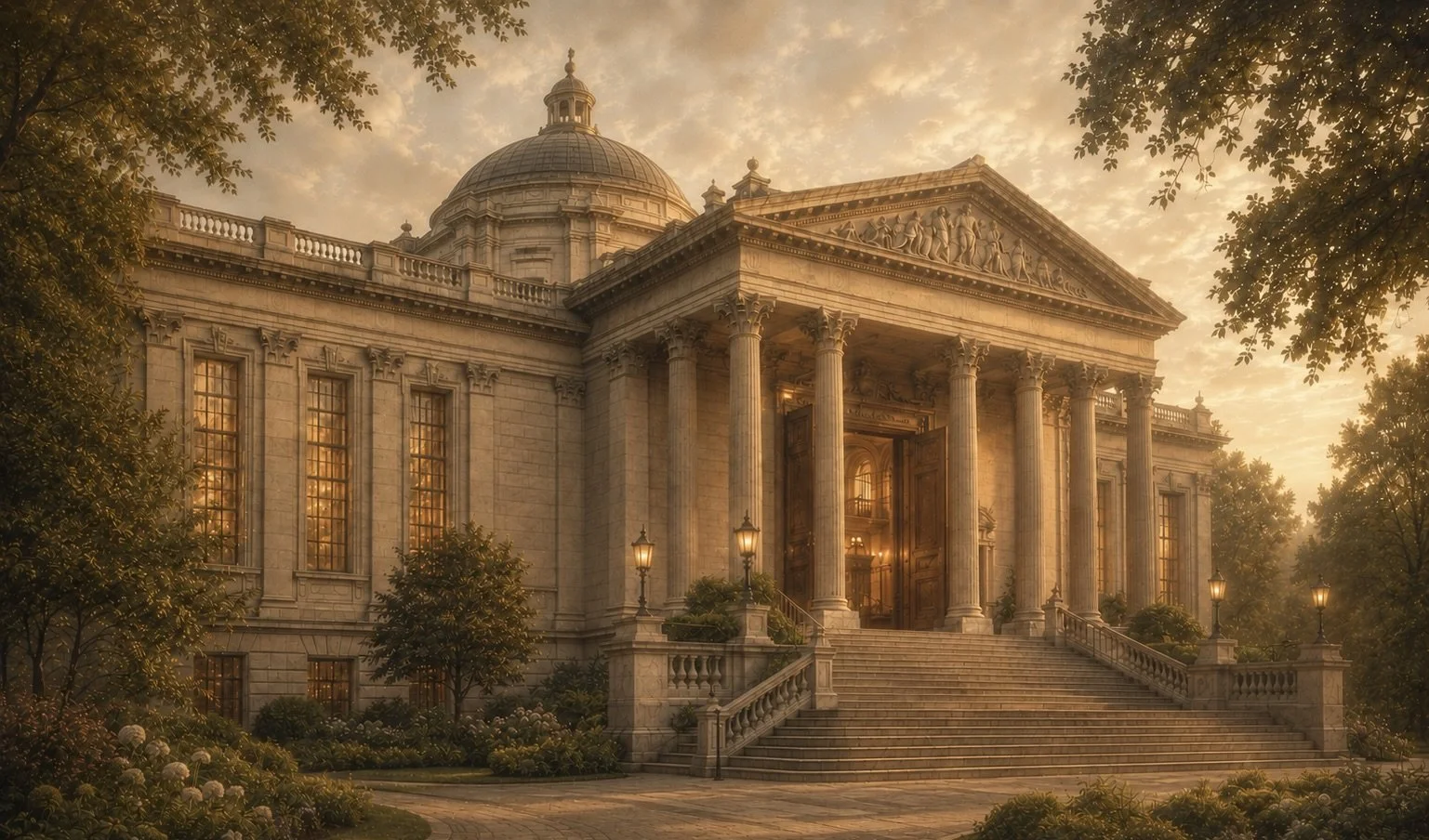
Vapor & Bloom
Heritage Museum
Nothing begins with us.
Collection I · Now Open
Enter The Hands Before OursAbout the Institution
Heritage Museum
Heritage Museum follows the hands, lives, and practices through which knowledge reaches us. We trace those who observed, taught, built, refined, repaired, challenged, and passed the work onward. Our collections restore attribution where the surviving evidence allows and keep uncertainty visible where it does not. Harm, exclusion, and unequal recognition remain part of this inheritance, asking us to receive what came before with gratitude, honest scrutiny, and a clearer sense of responsibility.
Keeper’s Vow
I will remember those whom history forgot.
Institutional Purpose
History is larger than the name attached to the milestone.
Heritage Museum preserves the long chain of human effort through which knowledge passes from one set of hands to another.
Its collections attend to the people, practices, observations, experiments, records, tools, failures, and acts of transmission that made later achievements possible. It is especially interested in the distance between an attributed achievement and the accumulated work required to reach it.
The Museum does not exist to tear down every person who received historical credit. Particular individuals may still have made remarkable and consequential contributions.
The Museum exists to restore the room around them.
The Nature of Discovery
Discovery is often the moment when a long accumulation becomes visible enough to receive a name.
The language already existed. Instruments had been made. Earlier observations had been preserved. Materials were gathered and prepared. Failures had narrowed the possibilities.
Witnesses made the event legible. Later hands transformed the event into a reliable practice.
Widening the Frame
A milestone is not the whole road.
The conventional account of an achievement often centers one exceptional figure, one decisive act, and one celebrated date. Heritage Museum begins there, but it does not stop there.
Whose hands made this possible?
The Narrow Frame
- One attributed figure
- One decisive event
- One surviving date
- One celebrated claim
The Widened Frame
- Earlier observations and parallel experiments
- Tools, materials, apparatus, and craftspeople
- Assistants, witnesses, students, and record keepers
- Patients and subjects whose bodies became evidence
- Failures, refinements, teaching, and later adoption
The Curator
Curator of Hands and Practices
The Curator follows the work itself.
The Curator does not collect famous objects merely because they belonged to famous people. Their attention goes to what human beings actually did.
They ask how an instrument was held, who prepared it, who made it, what procedure was repeated until it became reliable, who witnessed the result, who wrote it down, and whose hands received the knowledge next.
The Curator does not seek to replace one heroic account with another. Their responsibility is to make the record more complete without pretending it can ever be perfect: distinguishing evidence from inference, attribution from ownership, and absence of documentation from absence of contribution.
Labor, touch, making, treatment, and responsibility.
The repeated human actions through which an object becomes useful and knowledge becomes transmissible.
The Curator keeps the light attributable.
The Record of Inheritance
Heritage is responsibility.
To inherit knowledge is not simply to possess the result of earlier work. It is to receive the record that accompanies it.
Results
The knowledge and ability made available by previous hands.
Failures
The attempts, dangers, and mistakes attached to what we received.
Biases
The inequalities and assumptions preserved within the record.
Obligations
The responsibilities created by new knowledge and new ability.
Questions
The uncertainties that remain unresolved within the inheritance.
The Next Handoff
The duty to preserve, improve, and transmit what we received.
What reached us was carried.
The Standard of Evidence
Uncertainty is not a failure of the exhibition.
Heritage Museum is imagined, but its historical claims must remain grounded. The institution provides the rooms, curatorial perspective, collection structure, and visitor journey. It does not invent the history displayed within them.
When certainty is unavailable, the Museum names the condition of the evidence rather than manufacturing a more satisfying story.
Documented fact
Contemporary testimony
Later recollection
Disputed attribution
Reasonable inference
Missing evidence
Name not recorded. Work evident.
Historical visibility has never been distributed equally. Access to education, publication, professional standing, financial support, and institutions determined whose testimony was preserved and whose names became attached to the record.
The Museum does not fill every silence with an invented biography. It makes the silence visible and preserves the evidence of work that remains.
Absence of documentation is not proof of absence.
Questions Kept Here
The Museum asks:
- What was handed to us?
- Through whose hands did it pass?
- What was lost during the transfer?
- Who was omitted from the surviving record?
- What responsibility accompanies our inheritance?
- What are we doing with what we received?
- How will we hand it forward?
Heritage Museum · Collection I
The Hands Before Ours
The accumulated human work by which painless surgery became possible, understood not as the achievement of one heroic inventor, but as an inheritance carried through many hands.
This procedure is attributed to one man.
It appears to have required an entire room.
The collection follows humanity’s attempt to separate pain from consciousness through observations, substances, experiments, failures, apparatus, public demonstrations, written records, clinical labor, and acts of responsibility.
It begins before ether had a name, with the human longing to escape pain without surrendering life. From there, each handoff records something passing forward: a question, a method, an observation, a substance, a failure, a piece of apparatus, or a new responsibility.
The famous room gradually fills. What first appears to belong to a single attributed figure is revealed as an inheritance assembled by predecessors, patients, craftspeople, witnesses, assistants, students, practitioners, and unnamed workers.
History remembers milestones. We remember the miles between them.
Enter The Hands Before Ours Open Collection I →