Night Shift Observatory · Collection I
The Light in Transit
What continues to reach us after its source has disappeared?
About this collection
Free to explore online. Related physical items are available to purchase.
What you’ll explore
Seven records show how people prepare, notice changes, keep useful records, and pass responsibility to someone else—from lighthouse keepers and fire lookouts to modern handoffs.
Sources & works
Point Reyes lighthouse logs, Mount Fremont lookout photographs, Lapham’s tornado map, emergency-response manuals, and naval, weather, aviation, and space-station records. A clearly labeled fictional clinical example explores a modern handoff.
Art, books & objects
The Record of Watch Journal and Watch Record Cards give you places to record what changed, what you did, and what someone else needs to know. The Watchkeeper’s Set pairs the journal with the cards.
View the books & objectsOn taking the watch
What survives the watch?
The person leaves. The situation does not.
Across centuries, Keepers prepared, observed, recorded, and handed forward what another person would need. The people changed. The distance changed. The instruments changed. The obligation to leave something usable remained.
These seven records follow what can cross the interval between one watch and the next. This collection concerns what survives the watch.
How you prepare determines how you pass through what follows.
The first movement · Before
No watch begins at the beginning.
Night Shift Observatory · The Light in Transit
Record 01 · Condition Received · Before
Condition Received
Point Reyes Light Station · California
21 January 1888
Why this mattered
Authority transfers instantly.
Context does not.
A change of watch looks clean on paper: one person leaves and another takes charge. Psychologically, it is anything but clean. The incoming keeper steps into machinery already worn, routines already established, failures already interpreted, and work already unfinished.
The danger is not only what is broken. It is what the outgoing watch assumes everyone already knows. Memory feels complete to the person who holds it. To the next person, it arrives as fragments.
A handoff asks one mind to reconstruct another person’s situation from whatever has been made durable enough to remain.
The keeper’s log narrowed that gap. It gave the next watch a condition, a date, a witness, and a place from which responsibility could continue. It did not make the station whole. It made its condition shareable.
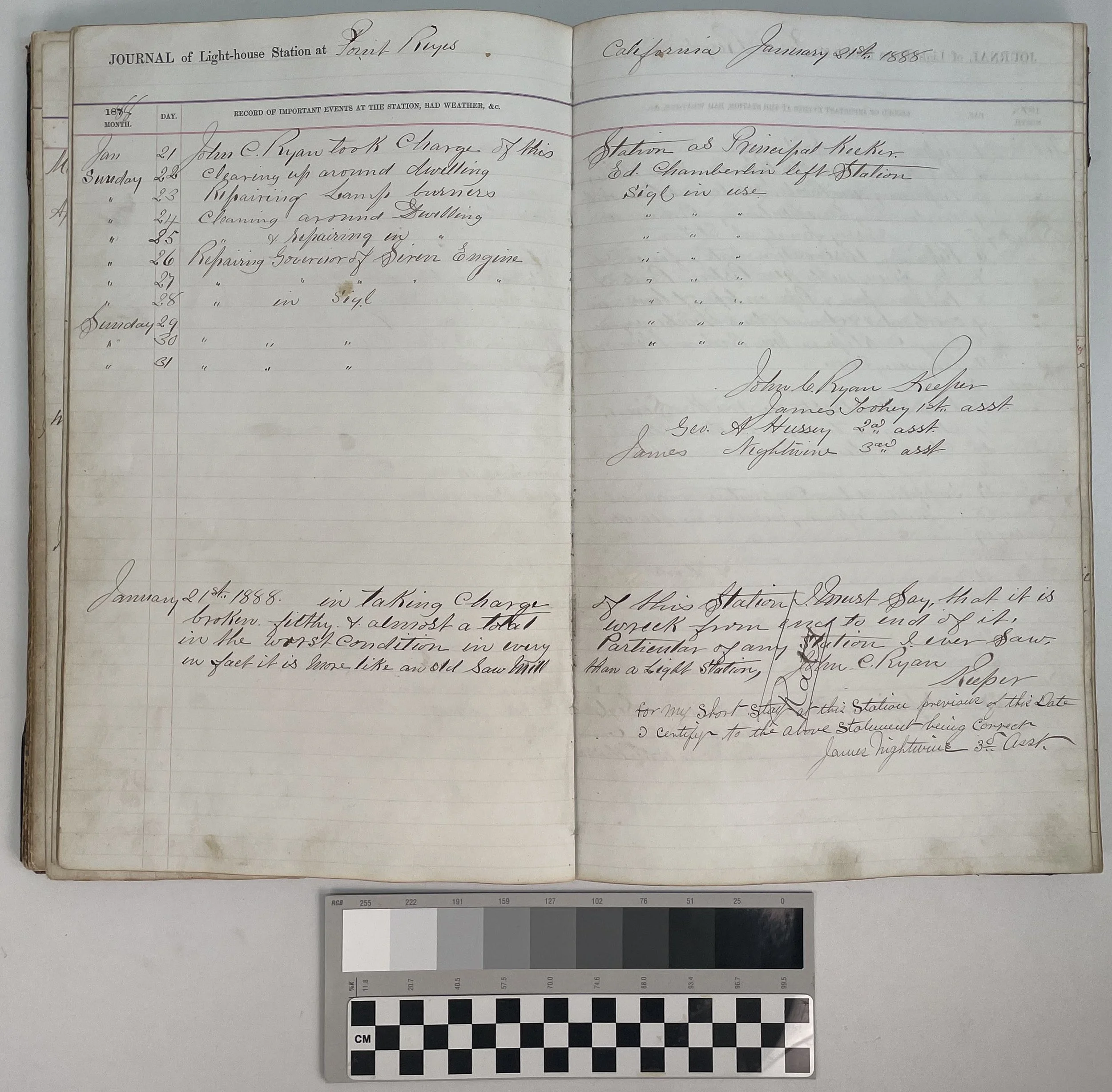
The watch is received
A condition enters the record.
“In taking charge of this station I must say, that it is broken, filthy, and almost a total wreck…” John C. Ryan · Principal Keeper · 21 January 1888
Ryan did not inherit a blank station. He inherited what another keeper had left, what the machinery had endured, and what the page could still make visible. His statement names the condition plainly. James Nightwire, third assistant keeper, certifies that account as correct.
Orientation
How to read the handoff
The spread is one continuous record, not two separate pages.
The line across the spine
Each ruled line begins on the left page and continues across the binding to the right. Date, daily work, weather or signal use, and personnel belong to the same horizontal entry.
The change of keeper
The first entry records John C. Ryan taking charge as principal keeper and Ed Chamberlin leaving the station. The transfer of authority is made visible before the work of the new watch begins.
The statement and certification
Ryan’s signed statement describes the received condition. Nightwire’s separate certification turns one person’s judgment into an attested institutional record.
The first days of repair
The entries immediately move from condition to care: clearing and cleaning around the dwelling, repairing lamp burners, working in the dwelling, and repairing the siren engine governor while the signal remains in use.

The condition is tended
Diagnosis becomes dated work.
February does not offer a triumphant repair. It offers something quieter and more credible: task after task, entered while the station continues to operate. The handoff becomes accountable through repetition.
-
2–3 Feb
New blowcock and pipe fitted to the boiler; the boiler cleaned and returned to order.
-
4 Feb
Lens machinery overhauled and a new cock installed in the water pipe near the tower.
-
6–9 Feb
Reservation gate, fence, steam siren, piston pin, burners, and clock machinery repaired or cleaned.
-
13–29 Feb
Siren, tower, lens, battery, dwelling windows, doors, gutters, workshop, and lantern cover repeatedly tended.
The pages around the moment
A handoff is not an isolated scene. The surrounding record gives it duration.

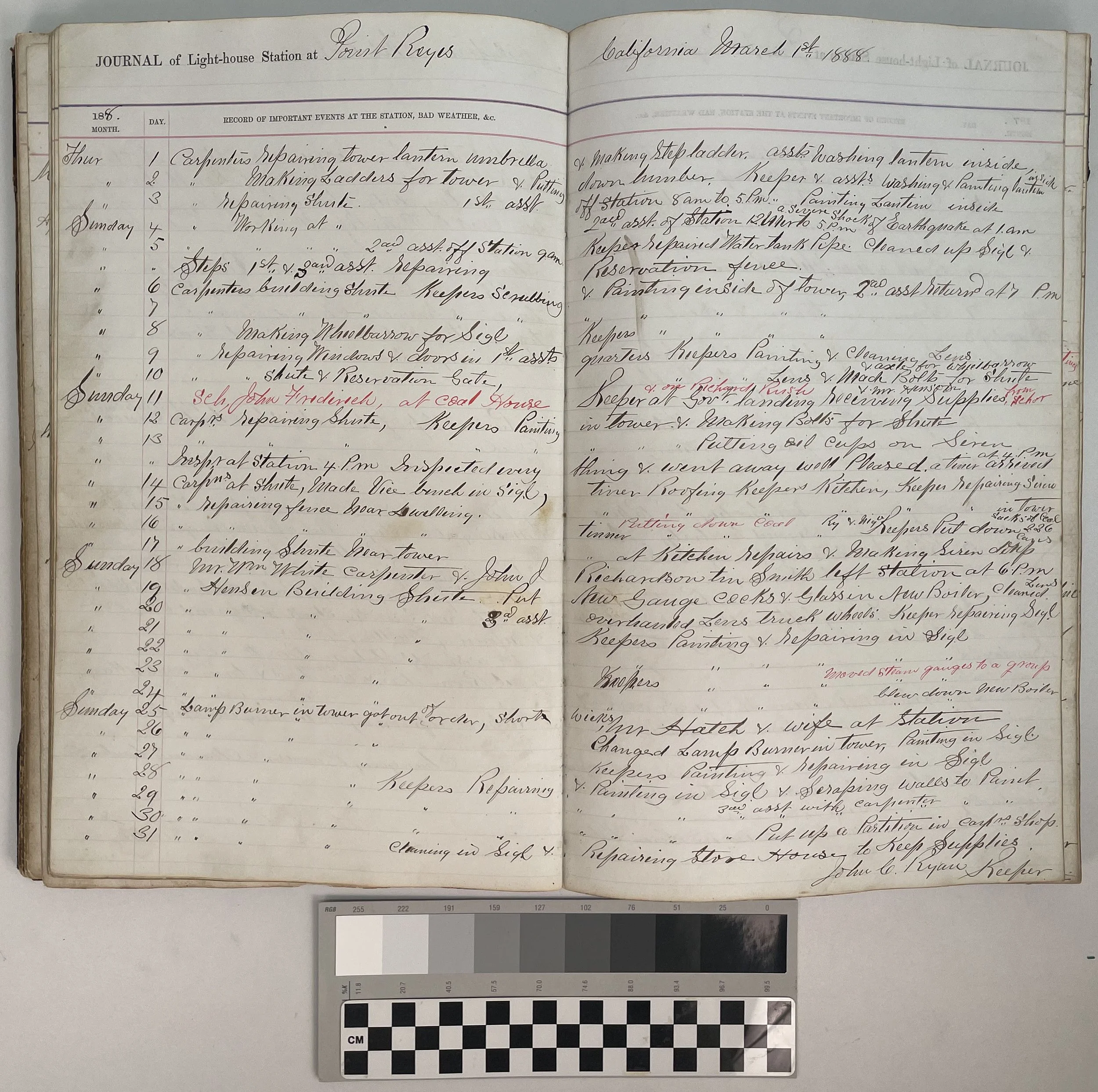
The preceding spread prevents Ryan’s statement from floating free of the watch that came before him. The March spread prevents the February repairs from looking like a finished rescue. Together, they show a station received in time and tended through time.
Observatory Note
The first act of the new watch was not to begin.
It was to tell the truth about what had been received. The logbook carried that truth beyond the departing keeper, beyond the first repair, and beyond the memory of anyone present at the station.
Care became continuous because condition could be handed forward.
No watch begins at the beginning.
With gratitude
Virginia Bones
Point Reyes National Seashore
We are grateful for her help in making photographs of the original Point Reyes lighthouse keeper’s log available to this collection, and for the care and guidance she offered along the way.
Thank you for helping this record reach its next keeper.
Night Shift Observatory / The Light in Transit
Record 02 / Before
Preparation
Air-raid precautions · United States · 1943
Before an emergency, someone had to learn the neighborhood: who lived there, who might need help, and which people and resources could be called upon. The 1943 Handbook for Air Raid Wardens described how to put that knowledge into records, make it available, and keep it current for whoever took over next.
Instructional source · Original printed pages · Revised June 1943
Evidence 01 / Printed page 12
What needed to be known
The handbook describes a household record assembled during visits by wardens and fire guards. Its fields move from names and addresses to the people who might need particular care and the people to contact if someone were hurt. Preparation begins with knowing enough about a household to help it.

Read the passage as text
Transcription / Printed page 12
Household Report Forms.
In many communities, information relative to buildings and occupants is assembled on uniform household report forms, individual copies being filled out in duplicate at each house or building by the Warden and the Fire Guard as they make their calls. These forms contain space for notations of name, address, business address, phone numbers; the number of adults and children regularly residing or working there; data regarding incapacitated persons and special care required for them; the religious denomination and name of clergyman of residents, in case of emergency; names, addresses, and phone numbers of relatives, close friends, and family physician to be notified in case of casualties; etc.
Evidence 02 / Printed page 13
A record for the next warden
Original household forms belonged at the Sector Post; wardens and fire guards retained duplicates for reference. The paragraph then names another reader: a new warden taking over. The knowledge was meant to remain useful through a change of keeper, provided the records were kept current.

Read the passage as text
Transcription / Printed page 13
The original copies of such report forms are filed at the Sector Post, and duplicate copies retained by the Wardens and Fire Guards for ready reference. Much of the data essential for the Warden can be entered in the ready reference forms in the back of this handbook—data regarding special hazards, handicapped persons, locations of emergency stations, addresses of persons skilled in various lines, locations of water, gas and electric cut-offs, etc. Both the household report forms and the record forms in the back of this handbook will be of real value to the Warden in time of emergency, and to a new Warden taking over in the Sector. However, neither the forms nor the records will be of real help to anyone unless they are kept strictly up to date at all times.
Night Shift Observatory
Observatory Note
“and to a new Warden taking over in the Sector.”
A Handbook for Air Raid Wardens / p. 13
Someone has to know the neighborhood before it becomes difficult to ask. A name, a place, a person who may need help: each detail can be gathered while there is time to listen and written where another person can find it.
The handbook makes room for a change of keeper. It names the new warden who will take over and gives that person something to receive. What one person has learned is meant to remain available after the responsibility passes to someone else.
That is why preparation belongs in this collection. Remembrance can begin before the event that will call upon it. The work is to learn what matters, give it a place, and return often enough to keep it true.
Remembrance can be written in advance of need.
Preparing the Watch Record
Preparation
Preparation is the practice that makes a Watch Record useful: learning what matters, making that knowledge available, and keeping it current for the person who comes next. These historical instructions give that practice a concrete foundation.
What does the next person need to know before the need becomes urgent?
Passage
Preparation leaves a place for what is already known. The watch that follows must notice what changes, and give that change a form another person can understand.
Night Shift Observatory · The Light in Transit
Record 03 · Time of Observation
The Unbroken Horizon
Mount Fremont · Mount Rainier National Park
17 July 1936
Why this mattered
Between seeing and being understood
High above the forest, the danger was not only the spark. It was the failure of translation. A lookout could see smoke while every person capable of responding stood somewhere else.
Between them lay the most variable instrument in the system: human language. Ridge, fold, basin, far side—each description bent around distance, habit, experience, and the private map inside the speaker’s mind. When the watch changed, that internal map changed too.
The Panoramic Lookout Project was, in part, a psychological intervention disguised as a photographic survey. It answered the instability of memory and description with a physical record. Hauled to remote peaks, the 75-pound Osborne photo-recording transit made a measured horizon: photograph, azimuth scale, level line, station, and date held together in one object.
It did not remove human judgment. It gave judgment a common coordinate system.
The observer no longer had to make words carry the whole mountain. A bearing could carry part of the meaning. The panorama could remain after the voice left the telephone line, be consulted somewhere else, and wait for the next watch.

The apparatus in use
A machine built to reduce human ambiguity still had to be carried—and positioned—by hand.
Courtesy National Park Service, NPS History Collection, HFCA-01951
Night Shift Observatory
The next observer did not inherit the previous observer’s eyes. They inherited the reference those eyes had used. This is the light in transit: perception made portable, memory made institutional, and one human mind given a way to reach another without requiring both to be present in the same place or moment.
Time of observation
One horizon.
Three exposures.
On July 17, 1936, National Park Service junior forester Lester M. Moe photographed the view from Mount Fremont using the Panoramic Lookout Project’s specialized Osborne photo-recording transit.
Photographs 858, 859, and 860 divide the landscape into three 120-degree sectors. Read from left to right, their azimuth scales travel from 180 degrees through north and return to 180 degrees, completing the circle.
The project’s standard method made the sectors at different times of day so the sun remained favorably positioned. No exposure times are inscribed on this set, so exact hours cannot be assigned. The apparently continuous horizon was ordinarily assembled from successive observations.
The 360-degree record
Begin at south. Pass through north. Return to south.
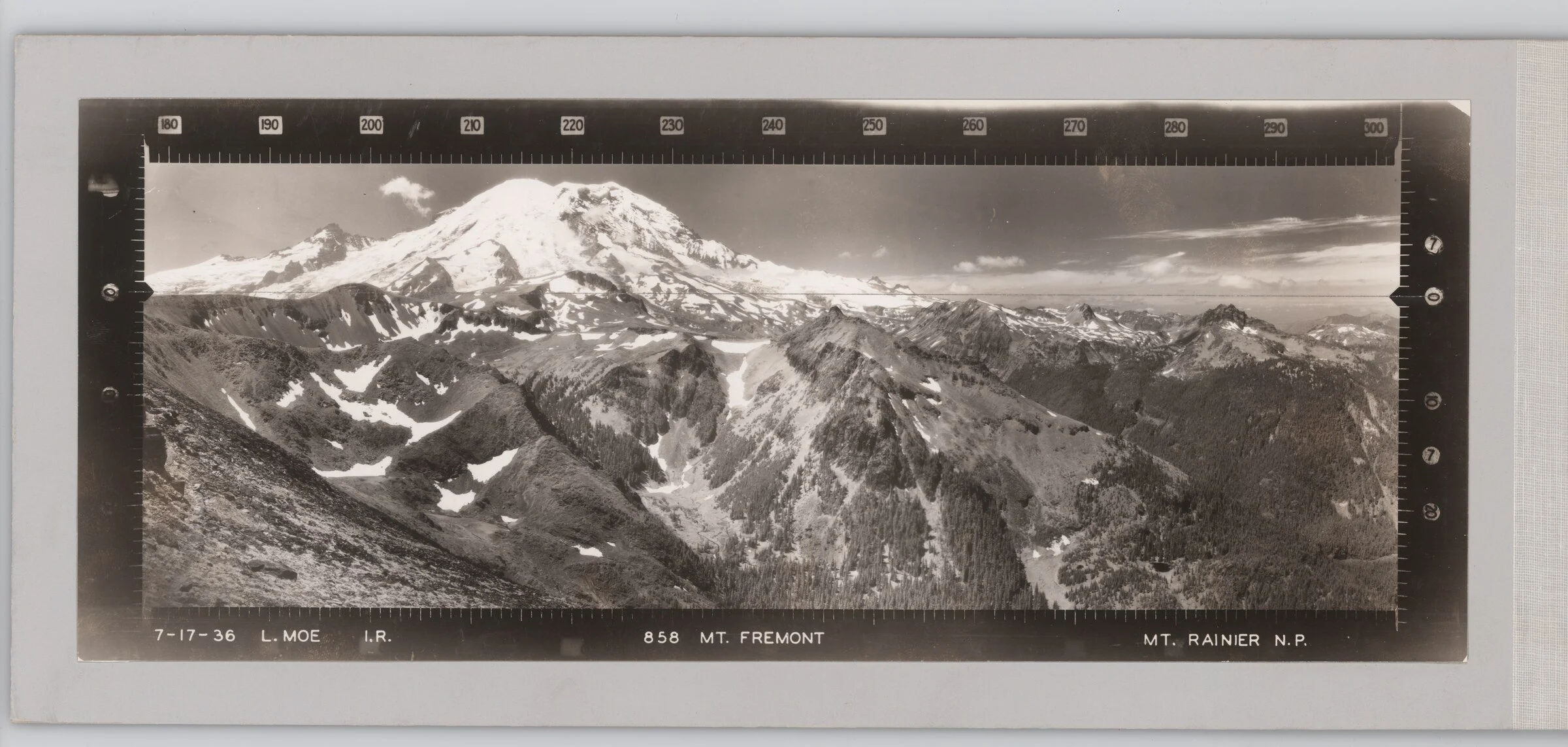
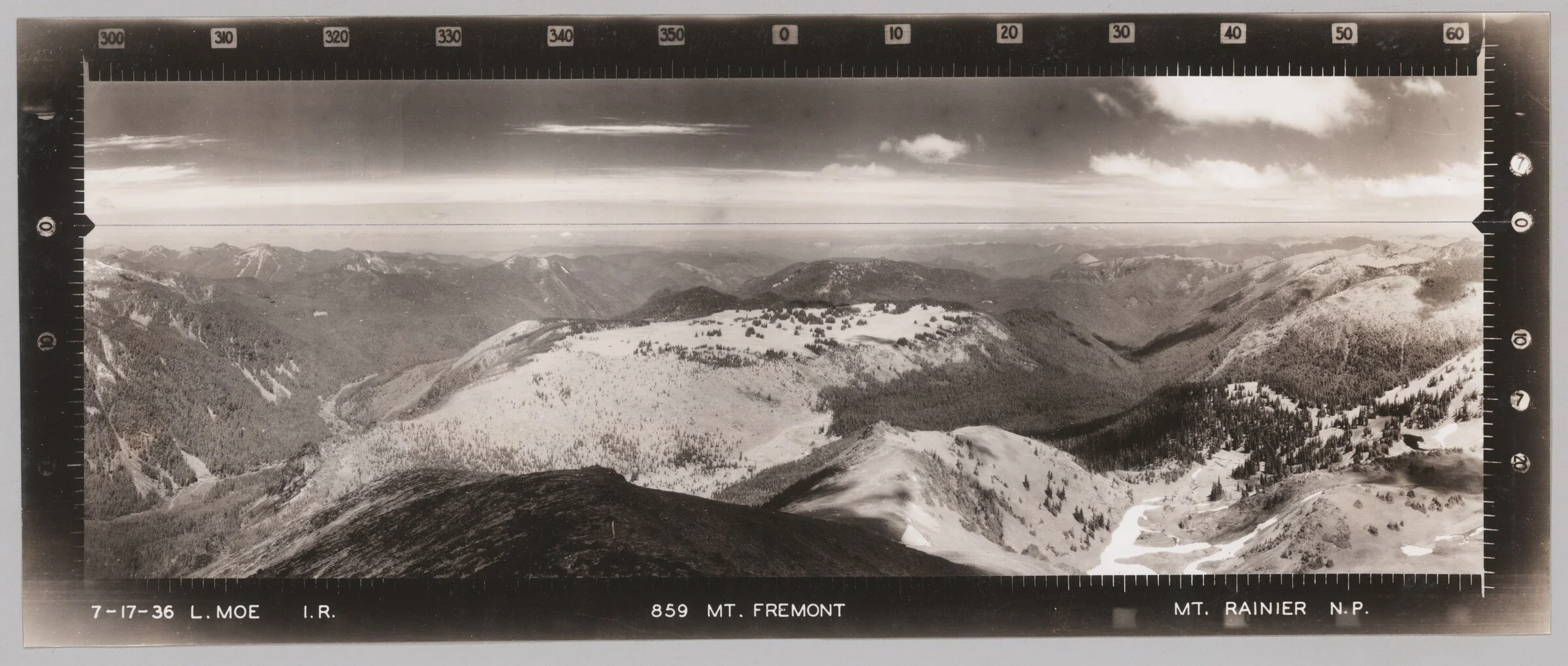
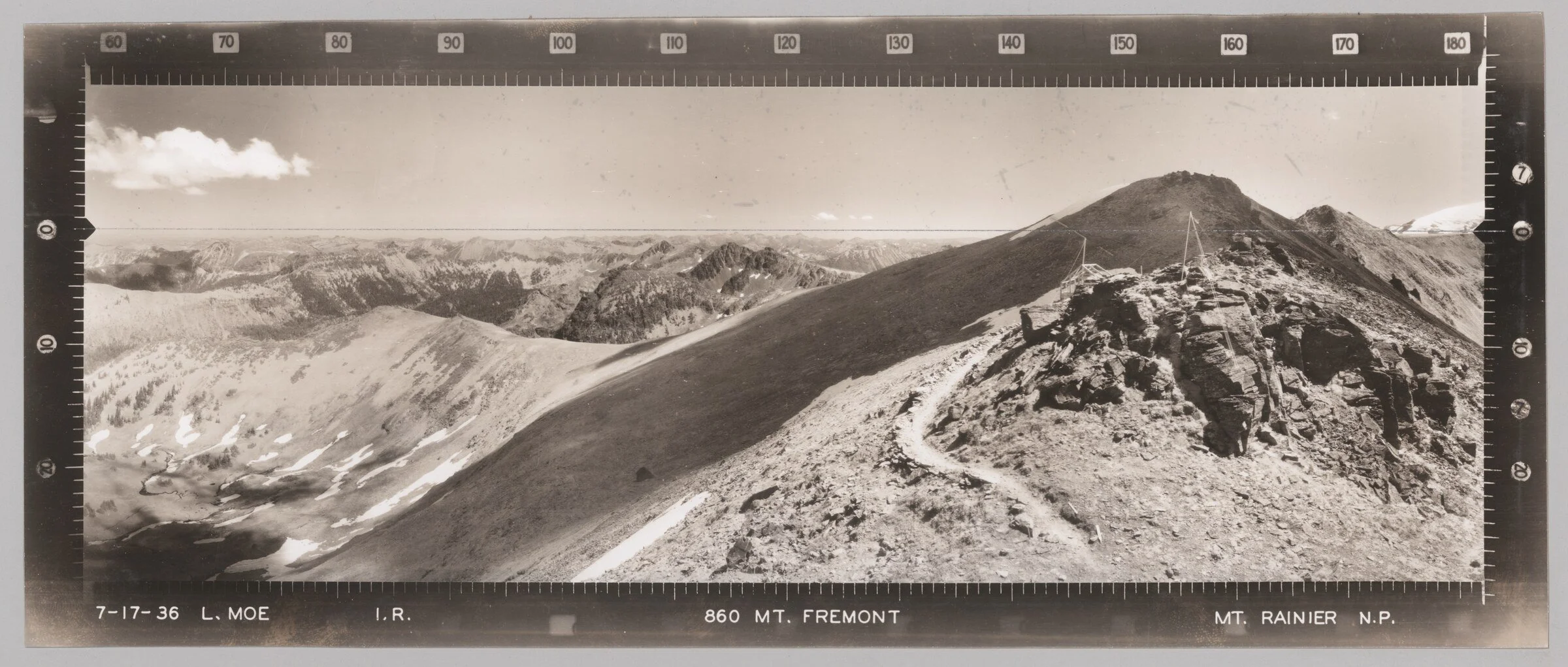
Swipe left to follow the horizon through all three sectors.
Lester M. Moe, Mount Fremont Panoramic Photographs, nos. 858–860, July 17, 1936. Infrared panoramic contact prints mounted as a folding triptych. Azimuth sectors: 180°–300°; 300°–60°; 60°–180°.
Orientation
How to read the record
The measurements are part of the photograph—not decoration added afterward.
The azimuth scale
The numbers above the landscape are compass bearings: 0 degrees is north, 90 east, 180 south, and 270 west. Fine divisions appear between the numbered ten-degree intervals.
The level line
The horizontal line is a calibrated zero-angle line, not the natural horizon. The National Park Service confirms that it was etched into the Mount Fremont negative.
The notation “I.R.”
“I.R.” identifies infrared film. It reduced atmospheric haze and increased the legibility of distant terrain—the part of the view fire personnel most needed to read.
Why three photographs?
The Osborne camera exposed a 120-degree sector at a time. The project normally scheduled each direction around the sun’s position. Together the three records create a complete view, but they do not claim to freeze the entire horizon in one instant.
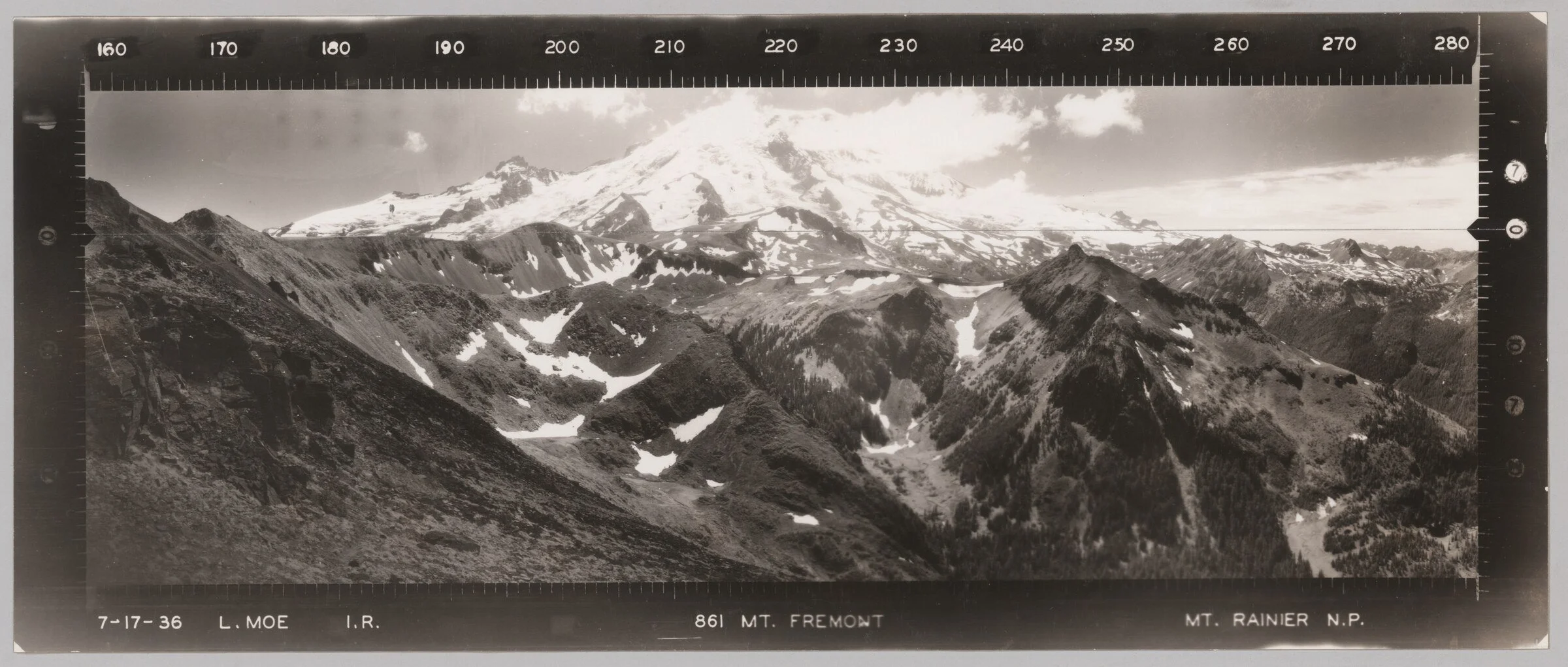
A second framing
The same place is observed again.
Photograph 861 overlaps the Mount Rainier-facing portion of the triptych, but it is a separate object. It does not complete—or extend—the 360-degree set. Its survival preserves another decision about how the same landscape should be held.
Observatory Note
The photograph is not scenery. It is a relay.
Moe fixed the horizon so people who were not present at the exposure could work from the same measured view. A sighting could be compared, telephoned, and acted upon. When one watch ended, the reference remained.
Attention did not stop time. It made knowledge handable.
The horizon became a handoff.
Archival Acknowledgment
Eleanore Kohorn
With gratitude to Eleanore Kohorn, Archivist, NPS History Collection, whose attentive archival care brought the complete Mount Fremont horizon back into view.
Night Shift Observatory · The Light in Transit
Record 04 · Change Observed · Passage
Change Observed
Wisconsin · 21 August 1857
Handed forward · 4 September 1857
Why this mattered
Change crosses
a field of witnesses.
A tornado moves beyond any single observer’s position. One person sees the sky change. Another sees the damage left behind. A newspaper fixes a place or time in print. Each account is partial because every witness stands somewhere.
Increase A. Lapham’s surviving note and map preserve the moment those fragments were placed in relation. On 4 September 1857, he sent the Smithsonian a mapped track of the 21 August storm together with extracts from the Milwaukee Sentinel.
The record does not overcome partial sight. It makes partial sight available to another mind.
What reached the archive is not the storm and not the full body of testimony. It is an assembled understanding: a note that hands the work forward and a map that lets separate observations meet on common ground.
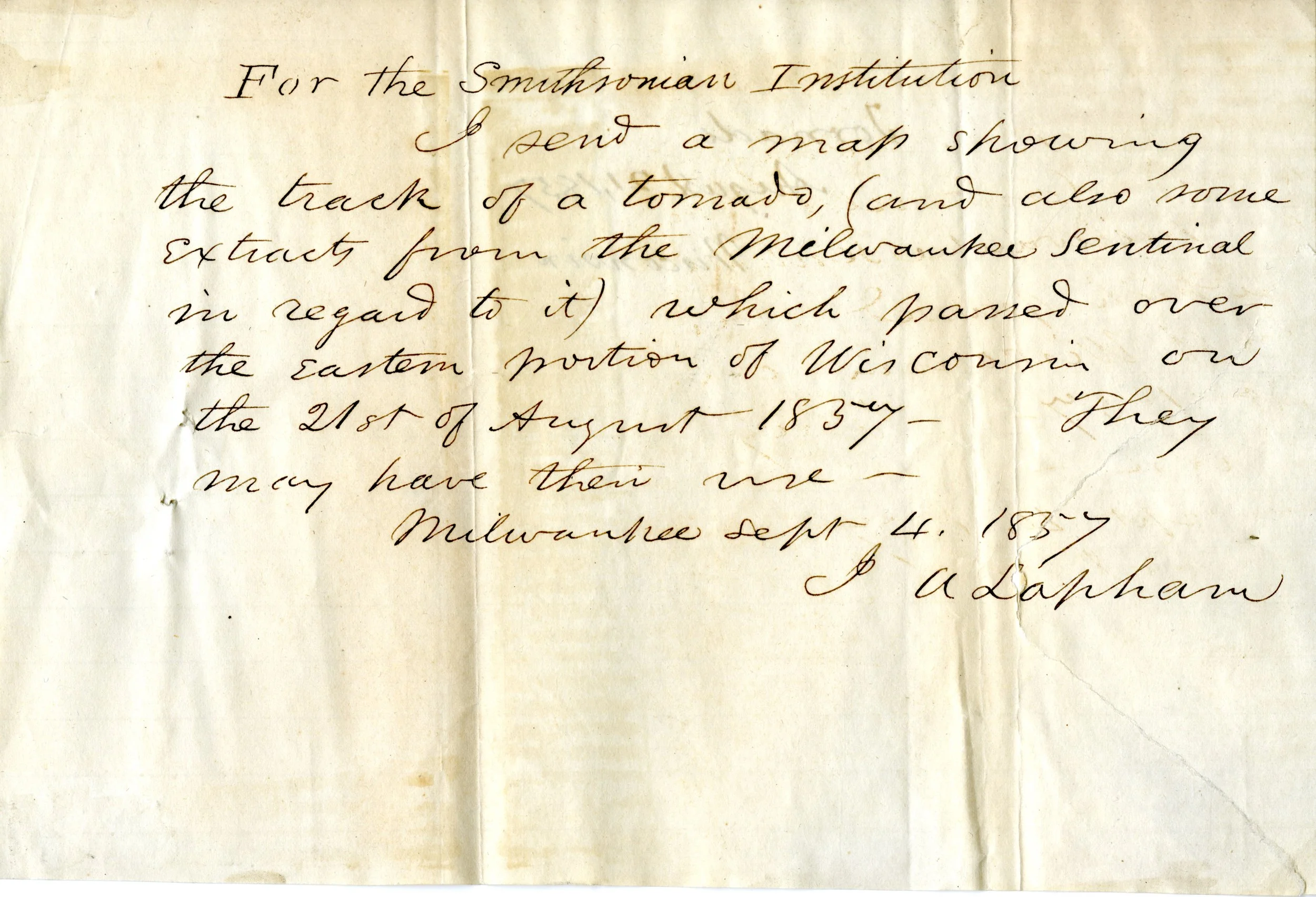
The handoff
“They may have their use.”
Lapham’s note is brief because it is not the observation itself. It is the act of transfer. It names what is being sent, identifies the event, and places the assembled material into another institution’s keeping.
Read the transmittal
For the Smithsonian Institution I send a map showing the track of a tornado, (and also some extracts from the Milwaukee Sentinel in regard to it) which passed over the eastern portion of Wisconsin on the 21st of August 1857 — They may have their use — Milwaukee Sept. 4, 1857. I. A. Lapham.
The assembled view
A path appears between positions.
The printed map supplies shared coordinates. Lapham’s line and written notations carry the reported change across county names, township grids, roads, waterways, and distances. The path becomes visible only because observations made elsewhere have been brought onto one surface.
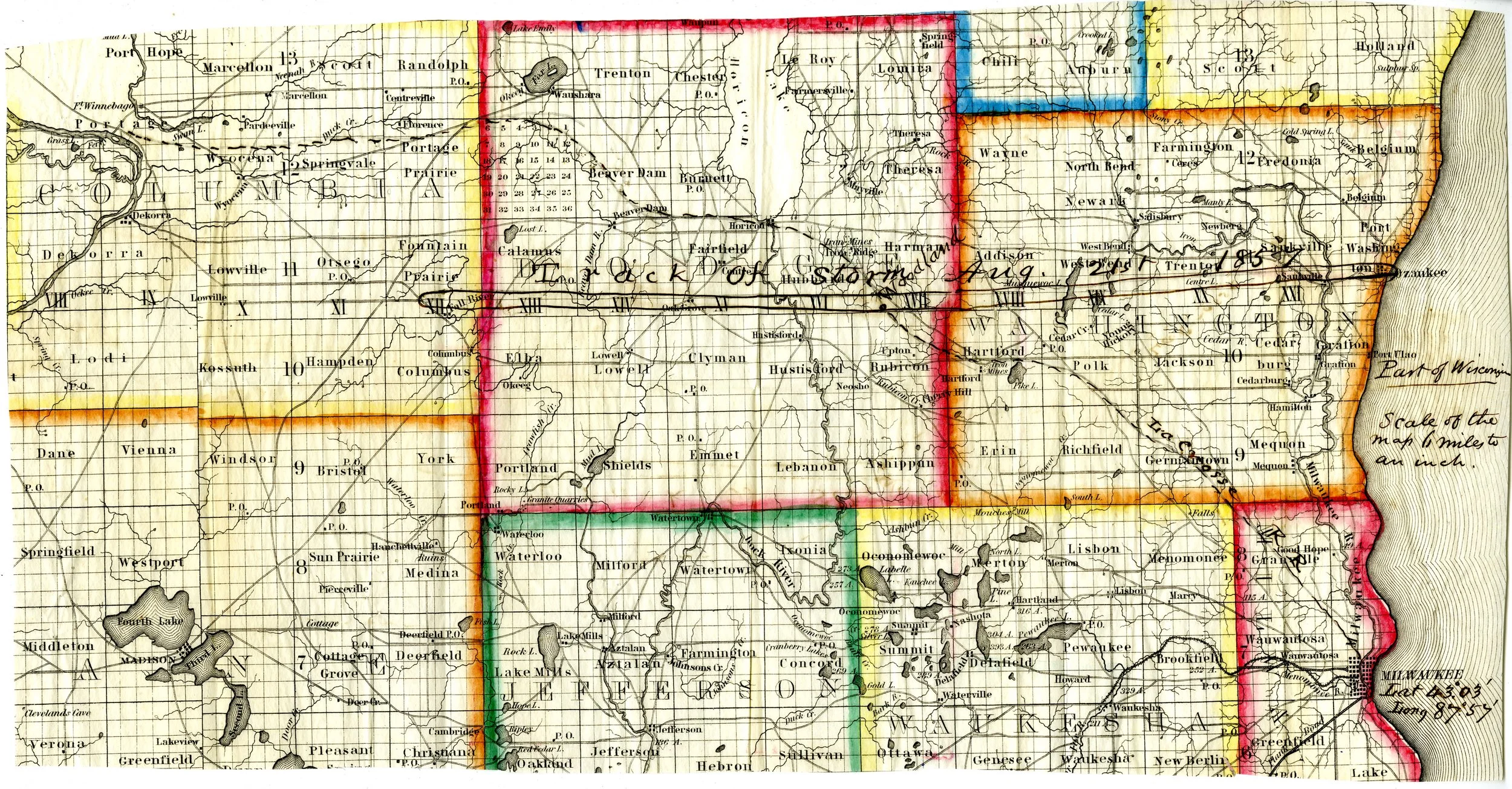
Orientation
How to read the assembly
The visible line is a relationship among fragments, not an uninterrupted eyewitness view.
The printed ground
County names, township divisions, settlements, roads, rivers, and the lakes give separate reports a common field in which they can be located.
The line of change
The dark route drawn across the map turns dispersed observations into sequence. Its continuity belongs to the record Lapham assembled, not to a claim that one person watched the entire passage.
The written notations
Handwritten dates, times, distances, locations, and scale notes show the work of positioning change rather than merely naming that a storm occurred.
The colors already present
The colored boundaries remain part of the surviving map. This record does not assign them an unverified role in the tornado’s path; it preserves them as evidence without forcing an explanation the archive does not supply.
The voices not retained
The supplied folder does not preserve Lapham’s eyewitness reports, newspaper extracts, observer returns, or telegraphic dispatches. Their absence limits what can be claimed even as the note and map preserve the shape of their assembly.
Working record
What the next keeper can receive
Time of observation
21 August 1857
Change observed
A tornado crossing eastern Wisconsin
Action taken
Reported observations assembled as a mapped track
Handed forward by
Increase A. Lapham
Time handed forward
4 September 1857
Remains unresolved
The underlying source observations do not survive in the supplied folder
Observatory Note
The record does not give us the storm as any one person saw it. It gives us the point at which separate sightings became shareable.
A line on a map is not the event. It is the work of placing fragments into relation so someone elsewhere — and someone later — can receive what no witness held alone.
No keeper sees the whole. The record lets fragments meet.
Night Shift Observatory / The Light in Transit
Record 05 / Passage
Action Taken / Remains Unresolved
Air-raid reporting · United States · 1943
The first report could leave before the whole situation was known. Further reports were expected to carry what the next survey revealed. At the control center, a request that could not yet be met had a place of its own: Needed.
Published reporting instructions and a control-panel design · June and December 1943
Evidence 01 / The initial and supplementary reports
Send what is known
The June 1943 Handbook for Air Raid Wardens instructed a warden to make a quick survey and send an initial report immediately. Complete details could follow after the needed services had been requested.
A more thorough survey came next. The handbook allowed as many supplementary reports as were needed to communicate developments, new information, and further requests. The first report began an account that could continue.

Read the passage as text
Transcription / Printed page 32
The Initial Report.
Immediately upon encountering an incident where assistance is required, the Warden should make a quick survey, watching particularly for fire, persons trapped in wreckage, casualties, UXBs, war gas, or blocked roads, and dispatch an initial report immediately to the Control Center, by telephone, WERS, or whatever other speedy means of communication may be available.
Only those points observable from a quick survey of the incident need be given in an initial report, complete details can be given later in a supplementary report, after the needed services have been requested.
The Supplementary Report.
After dispatching an initial report, the Warden should make a complete survey of the incident, checking carefully for damage he may have missed in his first quick survey, and for any additional developments. This information should then be dispatched to the Control Center by a supplementary report.
Supplementary reports always refer to an incident already reported. While there can be only one initial report on an incident, there can be any number of supplementary reports, as many as may be needed to keep the Control Center informed of developments, to request additional units or equipment, to report new information, etc.
Evidence 02 / Illustration No. 7
A place for what is needed
The December 1943 control-system manual pictured a panel with three distinct headings: Available, Dispatched, and Needed. Fire, rescue, and medical services could be tracked against numbered incidents.
The drawing makes room for both an action and a remaining need. A service recorded as dispatched had been sent; that entry alone did not establish arrival or resolution of the incident.

Read the diagram’s structure
Description / Illustration No. 7
The drawing is titled “CONTROL PANEL.” Its left-hand section is labeled “AVAILABLE” and is divided into “FIRE,” “RESCUE,” and “MEDICAL.” Each service area includes depot, reinforcements, and reservoir spaces.
To the right, two groups of columns have the headings “INC. NO.,” “DISPATCHED,” and “NEEDED.” The first group lists incident numbers 1–30; the second lists 31–60. The drawing includes construction dimensions and the label “Illustration No. 7.”
This is a description of the published design. The diagram contains no completed record of a particular incident.
Evidence 03 / Services needed but not available
Keep the unmet request visible
Section 7 sets out what to do when units are needed but cannot yet be dispatched. A representative records the type and quantity required. The Panel Clerk places an unnumbered service tag in the incident’s Needed space as a reminder.
The Incident Report remained on the representative’s table. Once units were available and dispatch was ordered, the report went to the Panel Clerk, who posted Services Dispatched and removed the Needed tag. The unresolved request had a visible place while it waited for action.

Read the passage as text
Transcription / Printed page 38
7. ACTION TAKEN ON SERVICES NEEDED BUT NOT AVAILABLE.
a. Conditions Requiring “Services Needed” Action.
The Representatives of the Emergency Services may determine that units are required at an incident, but that none can be dispatched at the time, either because no service units are available, or because the air raid situation is such that it does not seem wise to dispatch any of those services which are still available.
b. Identification of Incidents Where Services Are Needed.
If service units are needed, but are not available, the Representatives (or their Aides) will prepare a General Message form (only one sheet) noting on it plainly the type and quantity of service units needed. The form will go to the Panel Clerk who will take an unnumbered tag from the appropriate service reservoir and hang it in the space for that incident in the “Services Needed” section of the panel. This tag will serve to remind the service representatives of the fact that services are required at that incident.
c. Clearing “Services Needed.”
As soon as units are available for dispatch, the orders are given and the Incident Report form, which has remained on the table in front of the representative, is filled out and forwarded to the Panel Clerk. He posts “Services Dispatched” and removes the tag from the “Services Needed” section. The copy of the report is then routed to the Records Officer.
Night Shift Observatory
Observatory Note
A report may end while the need continues.
These instructions gave unfinished work a place to remain visible. What had been observed could be sent onward. What could be dispatched could be marked. What was still needed could stay before the people responsible for the next decision.
The tag did not meet the need by itself. It kept the need in view. The report on the table held a place for an action that had not yet become possible.
To keep watch was also to leave a clear account of what remained beyond the action already taken. Another person could receive that account and continue from it.
A faithful record does not require a finished story.
The Watch Record / Action and Unfinished Work
Action Taken / Remains Unresolved
In the Watch Record, Action Taken and Remains Unresolved hold what has been done alongside what is still needed, unknown, or unconfirmed. The next person should be able to see where the action reached and where responsibility continues.
What has been done, and what must remain visible for the next person?
What Morning Receives
Some needs outlast the person who first records them. To leave them visible is to give the next watch a place to begin.
Night Shift Observatory · The Light in Transit
Record 06 · Handed Forward To · What Morning Receives
Handed Forward To
USS Abbot (DD-629) · 6 June 1951
Deck Log—Remarks Sheet · Page 14
Why this mattered
One moving vessel.
Seven watches.
Four signing officers.
A watch ends. The voyage does not.
At midnight on 6 June 1951, the deck log of USS Abbot establishes the vessel’s inherited condition: underway from San Diego toward the Panama Canal Zone, steaming in company, holding a stated course and speed, and advancing the ship’s clocks by one hour.
At 0400 another officer receives the watch. The first words of the new entry are not a fresh description. They are “Steaming as before.” The phrase returns at every remaining watch division on the page. New work is added when something changes; the continuing condition does not have to be rediscovered.
The page remains one record because no single officer is required to remain its only witness.
Signatures make each interval accountable. Repetition carries the known condition. Exact times preserve the additions. Together they allow one person’s attention to stop without forcing the watch itself to disappear.

The surviving page
The handoff is visible in the form.
The sheet divides one day into seven signed periods. Each officer writes inside the same documentary structure: time at the left, condition and action across the page, signature at the close.
The changing handwriting matters because it shows continuity without pretending sameness. Different people inherit the same moving situation, add what their interval requires, and leave the page usable for whoever follows.
Read the opening-condition summary
The 0000-0400 entry records USS Abbot steaming with USS Shangri-La and USS Melvin, en route from San Diego to the Panama Canal Zone on a stated base course and standard speed.
It also records formation position, the boiler in use, material condition Baker, and the 0100 time-zone change. Later watches inherit that baseline and record only what their own hours add.
The recorded day
Responsibility changes hands.
The sequence below follows the actual watch divisions, phrases, additions, and signatures visible on the page.
0000-0400
Establishes course, speed, formation, machinery, material condition, and the time-zone change.
W. W. Knotts
0400-0800
Steaming as before. Steering is shifted and alarms are tested at exact times.
R. R. Webb
0800-1200
Steaming as before. Muster, exercises, ammunition counts, and magazine inspection are added.
R. G. Lalicker
1200-1600
Steaming as before. The inherited condition remains sufficient for this interval.
W. A. Withers
1600-1800
Steaming as before. A returning officer signs the continuing condition.
W. W. Knotts
1800-2000
Steaming as before. The same brief phrase passes the established condition onward.
R. R. Webb
2000-2400
Steaming as before. A timed salt-water-ballast operation is recorded before the day closes.
R. G. Lalicker
The repeated condition
Repetition is not an empty space.
“Steaming as before.”
The phrase does not mean that nothing happened. It means that the prior condition remains in force unless the next entry says otherwise.
A faithful record does not rewrite the world at every change of keeper. It distinguishes what continues from what has changed, allowing attention to move forward without severing itself from the hours already lived.
Handoff register
What the next keeper receives
Continuous subject
One vessel underway through one recorded day
Condition inherited
Course, speed, formation, machinery, and material readiness
Handoff language
“Steaming as before”
Responsibility visible as
Timed entries and officer signatures
Changes added
Steering, alarms, exercises, inspection, and ballast
Handed forward to
Each successive signed watch
Observatory Note
The page does not ask one person to remain at the post forever. It asks each person to leave the next watch a truthful condition.
Continuity is not the absence of departure. It is what makes departure safe. The outgoing keeper may rest because responsibility has not been abandoned. It has been received.
The watcher changes. The watch continues.
Night Shift Observatory · The Light in Transit
Record 07 · Time Received · What Morning Receives
Time Received
Four operating systems
Weather · Airspace · Body · Orbit
Why this mattered
The final field
is a time.
By this point, the record can name a condition, a change, an action, and a need that remains. The final question is who can continue from it, and when that responsibility becomes theirs.
These four examples show different parts of that continuity. Weather records carry revised judgment forward. Airspace procedures make assumption of responsibility explicit. A fictional clinical exhibit shows what acceptance can require. An orbital summary gives completed work a next-day horizon.
A date can locate a record in time. A completed handoff also needs a receiver. The examples bring both parts into view without claiming that every surviving document records an actual transfer.
Weather · Issued record
Three packages. One developing condition.

Read enlarged document here
Scroll across and down to read the document. On a phone, swipe within the image. With a keyboard, focus the image area and use the arrow keys.
At 00:48 CDT, the Houston/Galveston forecast discussion names the expected landfall, the rainfall threat, and the uncertainty in the track. At 06:46, the overnight discussion remains in force while a new aviation section records what the morning has begun to show. At 12:25, the office issues a newly observed position and a changed time horizon.
Each product carries its own WMO header and issue time. The later record does not erase the earlier act of attention. It receives it, tests it against new observation, and states what the next reader should now use.
The plate preserves each issued header and one short exact excerpt. Dated capture notes retain the issue times, identifiers, official links, and access date. No NOAA or NWS logo is reproduced.
Airspace · Position relief
The receiver must do more than arrive.

Read enlarged document here
Scroll across and down to read the document. On a phone, swipe within the image. With a keyboard, focus the image area and use the arrow keys.
The FAA procedure begins before the verbal briefing. The relieving specialist reviews the written status, observes the equipment and operational situation, listens, and then signals readiness to begin. Abnormal conditions and questions are exchanged before responsibility moves.
Transfer occurs at an explicit moment: the relieving specialist indicates that position responsibility has been assumed; the outgoing specialist releases the position and notes the time. The position is then reviewed again for anything overlooked or displayed incorrectly.
The daily facility record preserves the same ethic across a longer interval. Its first remarks entry identifies the person responsible for the watch and carries forward outages, airspace status, procedures, and other unresolved facts.
The form is the FAA’s public example figure. No live traffic, current facility data, FAA seal, or implied agency endorsement is included.
Body · Clinical handoff
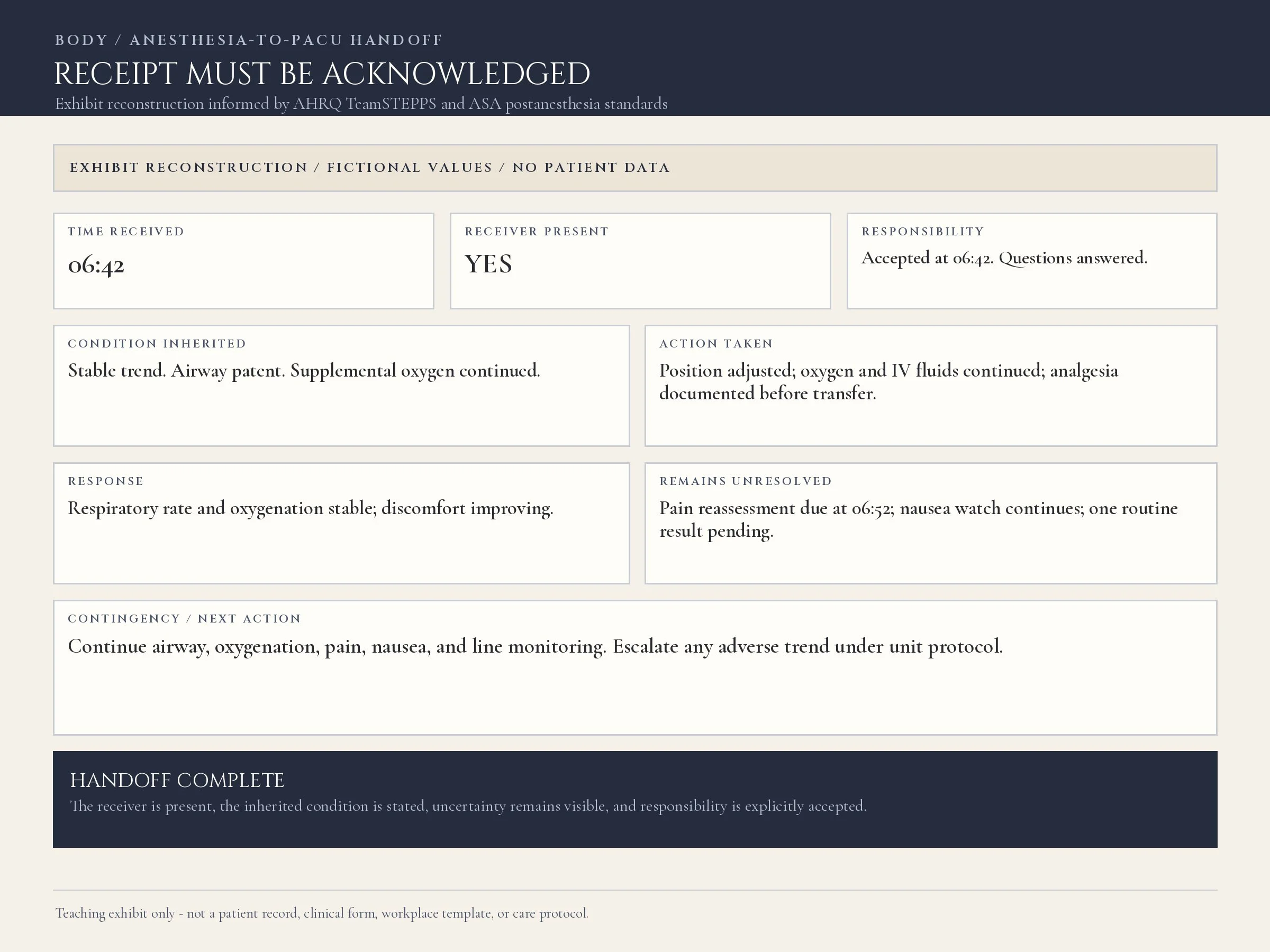
Presence is not the same as acceptance.
Read enlarged document here
Scroll across and down to read the document. On a phone, swipe within the image. With a keyboard, focus the image area and use the arrow keys.
AHRQ describes a handoff as the transfer of information together with authority and responsibility. The receiver needs the present condition, the response to treatment, recent changes, uncertainty, contingencies, and the opportunity to ask questions.
The ASA postanesthesia standard makes the threshold plain: the anesthesia-care team member remains with the patient until the receiving nurse accepts responsibility. The handoff is therefore not complete at the doorway. It is complete when the receiver can act on what has been entrusted.
The object shown here is intentionally fictional. Its purpose is to expose the structure without borrowing anyone’s body, chart, workplace, or identity.
Teaching exhibit only. It contains no patient identifiers, real event date, facility, clinician, procedure, diagnosis, signature, or case-traceable detail. It is not a clinical form or care protocol.
Orbit · Daily summary
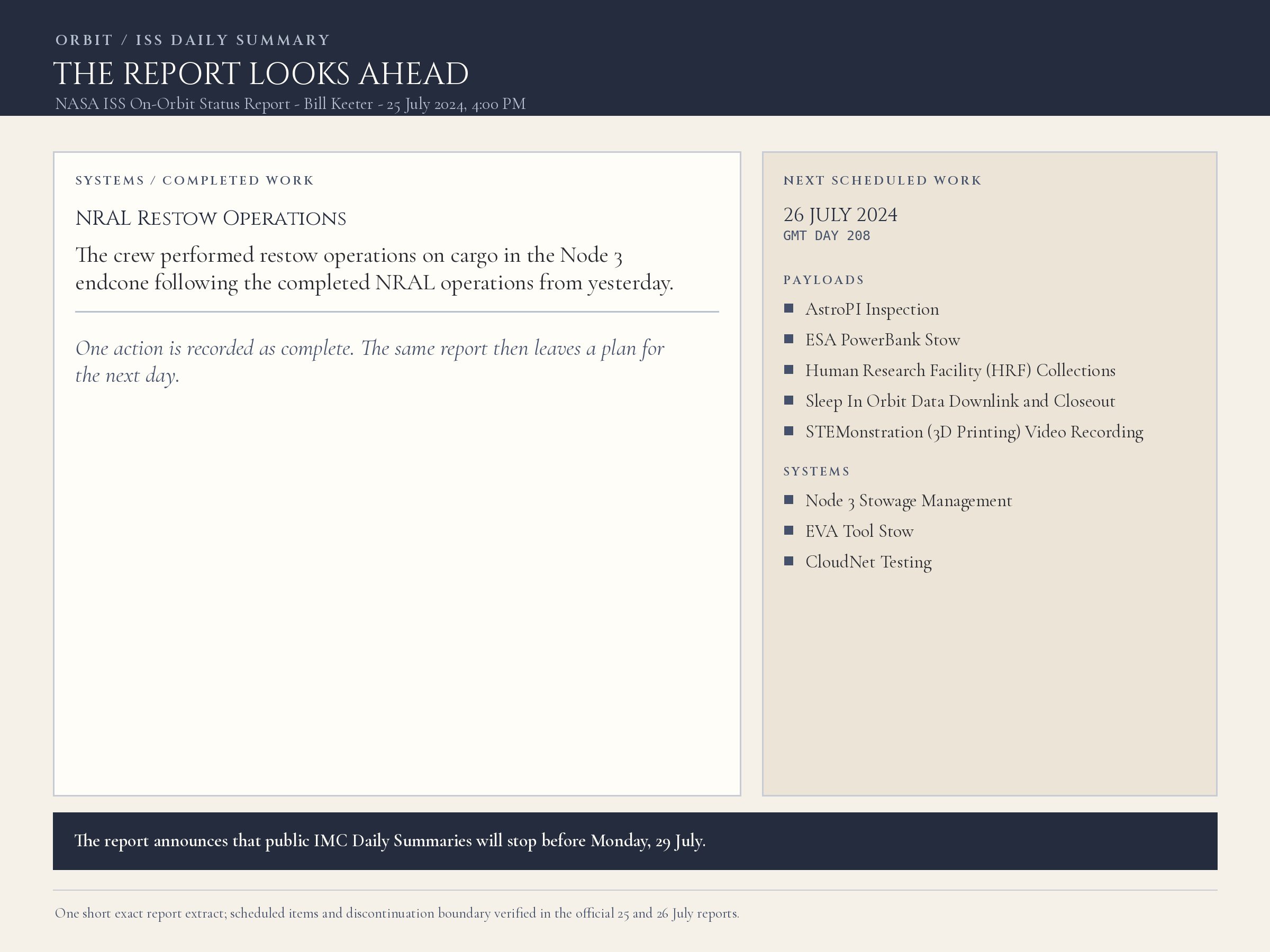
Completed work becomes the next day’s ground.
Read enlarged document here
Scroll across and down to read the document. On a phone, swipe within the image. With a keyboard, focus the image area and use the arrow keys.
The 25 July 2024 ISS Daily Summary records what the crew completed, then changes grammatical tense. Under Look Ahead Plan, it names the payload and systems work intended for Friday, 26 July. What is done and what must follow remain separate, but they inhabit one report.
At the bottom, the series also marks an ending: notice that the IMC Daily Summary will be discontinued beginning 29 July. The 26 July report repeats the notice and is the final summary linked after the selected page. A series may stop; its last record can still state where attention should go next.
Exact report extracts are reproduced for an informational exhibition. NASA insignia, page chrome, astronaut likenesses, and promotional imagery are omitted. No endorsement is implied.
Across four systems
Continuity takes action.
These examples give inherited information a next use: a revised forecast, an explicitly assumed position, an accepted responsibility, or a plan for the following day. Together they show why a record needs both usable information and someone able to continue from it.
The complete Record of Watch
What must survive the watcher
Seven fields keep attention usable across departure. Together they are not a monument to the person who leaves. They are working conditions for whoever arrives.
Before
Passage
What morning receives
Observatory Note
Attention survives absence only when another person can say what they received, what remains uncertain, and when responsibility became theirs.
A record is not memory stored. It is responsibility made transferable.
The technologies change. The practice remains.
End of the Collection Record
The watch has changed hands.
You entered with the watch already underway.
Across these seven records, the watcher changed. The instrument changed. The distance changed. The obligation remained: leave the condition legible enough for another person to continue.
What one Keeper could not finish alone was made continuable through another.
The question carried through the collection
What continues to reach us after its source has disappeared?
Care made usable.
A condition named. A change given a time. Uncertainty left visible. Responsibility placed into another person’s hands.
Before you leave, consider what another person will need because you were here.
Leave it where they can find it. Leave it clear enough to use.
Then rest.
The watcher changes. The watch continues.
End of Watch
The Light Always Returns.
Until it does, the watch is kept. What is observed is recorded. What has been learned is placed into the hands of morning.
Continue through the archive
The collection record ends here. The larger work remains open.
Night Shift Observatory · The Light in Transit · NSO-C01 · MMXXVI
Objects from this collection
Leave a record for the next watch
A journal, record cards, and the Watchkeeper’s Set carry the practice of noticing and handing forward into daily life.